
Table of Contents
If you’ve been quoting sportswear manufacturers and keep hearing “OEM” and “ODM” thrown around like everyone’s supposed to already know the difference — you’re not alone. Most brand owners get to the bulk-order stage before anyone actually explains what these terms mean, and by then a wrong decision is already expensive.
This guide is written for exactly that moment: right before you sign a production agreement, when you need technical clarity, not sales language. We’ll walk through what OEM and ODM in sportswear manufacturing, how the actual manufacturing process works step by step — from pattern making to screen printing and sublimation — and which model makes sense for where your brand is right now, whether you’re working with an OEM Production company for the first time or switching manufacturers.
What Is OEM and ODM in Sportswear Manufacturing?
Let’s cut through the jargon first, because this is where most confusion starts.
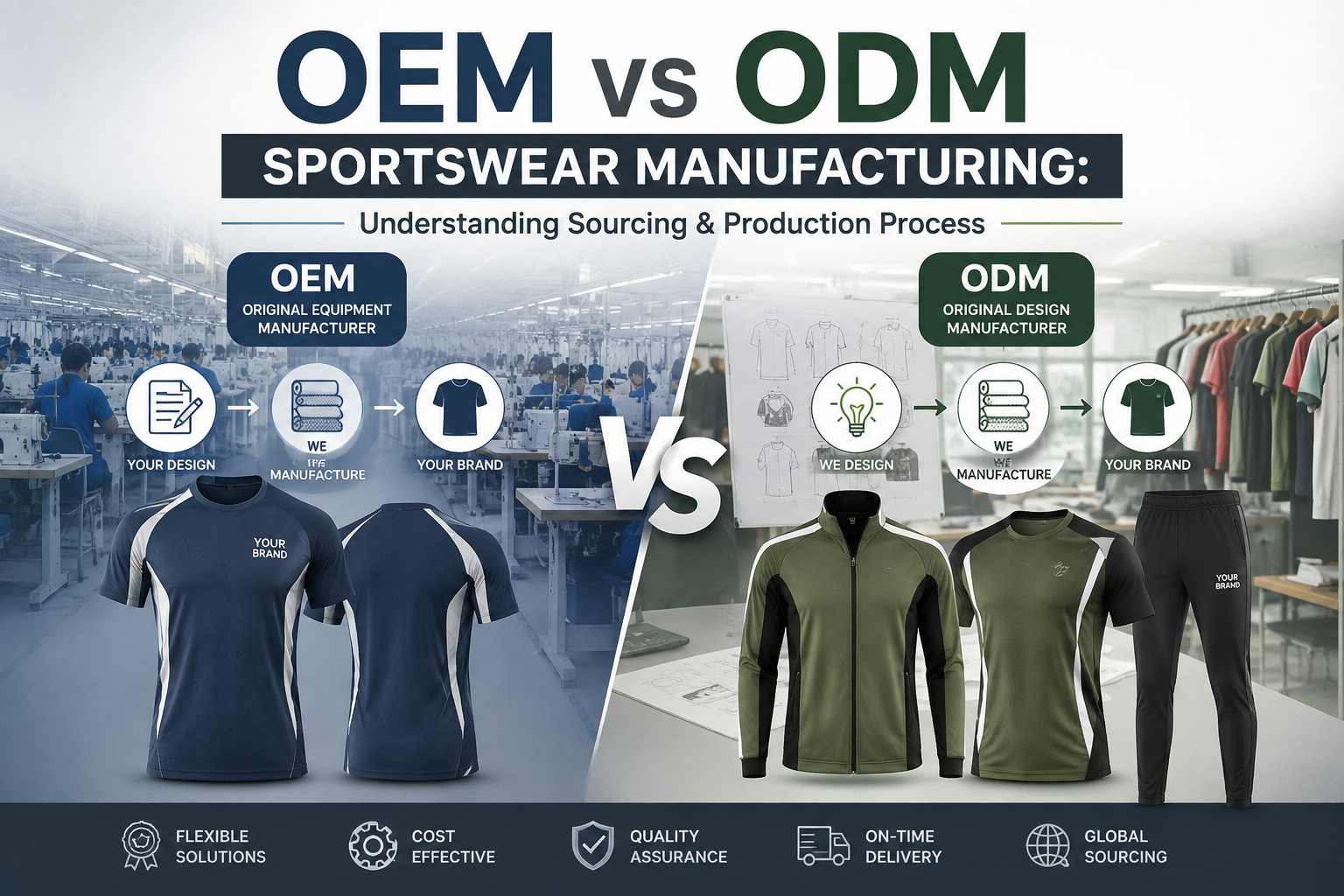
OEM (Original Equipment Manufacturer) means you bring the design. Your tech pack, your pattern, your fabric specs, your fit — the factory’s job is purely production. They cut, sew, and finish exactly what you’ve specified. You own the intellectual property, the fit is unique to your brand, and no other company can order the same garment from that factory.
ODM (Original Design Manufacturer) flips that. The manufacturer already has a library of developed patterns, base garments, and sometimes full pre-built collections. You choose a base style, adjust colors, fabric, or minor details, apply your logo and labels, and you’re production-ready. The design work is already done — you’re customizing the surface, not building from zero.
Think of it like renting a furnished apartment versus building a house. With OEM, you’re the architect — every wall, every measurement is yours, but it takes longer and costs more upfront. With ODM, you move into something already built and make it feel like home fast.
Neither model is “better” in absolute terms. It depends entirely on your brand’s stage, budget, and how much you care about having a genuinely unique product versus getting to market quickly.
OEM vs ODM: A Side-by-Side Breakdown
| Factor | OEM | ODM |
| Who designs the product | Your brand | The manufacturer |
| Design ownership | You own the IP | Factory retains design rights |
| Uniqueness | Fully exclusive to your brand | Shared base, limited exclusivity |
| Speed to market | Slower (sampling, tech pack rounds) | Faster (design already exists) |
| Upfront investment | Higher (R&D, sampling, pattern work) | Lower |
| Typical MOQ | Often higher | Frequently lower per style |
| Best for | Established brands with a clear identity | Startups and brands testing the market |
Most brands don’t stay in one lane forever. A common path is starting with ODM to validate demand cheaply, then shifting core, best-selling styles into OEM once you know they sell — building brand-owned exclusivity where it actually pays off.
What Is an Original Equipment Manufacturer, Really?
The term “original equipment manufacturer” gets used loosely, so here’s the precise version: an OEM Production company builds physical products to another company’s exact specifications, without contributing to the design itself. In sportswear, that means the factory has pattern makers, cutting tables, sewing lines, and finishing capacity — but the creative direction, fit, and fabric decisions come entirely from you.
This matters more in sportswear than almost any other apparel category, because performance garments live and die on fit precision. A compression legging that’s 3mm off in the waistband can be the difference between a five-star review and a return. An OEM Production company that understands technical sportswear — not just basic tees — is worth more than one offering the cheapest quote.
The Full Manufacturing Process, Step by Step
Understanding the manufacturing process end-to-end is what separates brand owners who negotiate confidently from those who get surprised by delays and hidden costs. Here’s how it actually unfolds, whether you go OEM or ODM.
1. Design and Tech Pack Development
For OEM, this stage is entirely on you (or your design partner): measurements, fabric specs, stitch types, artwork placement, and colorways documented in a tech pack. For ODM, the manufacturer hands you an existing spec sheet, and you mark up the changes you want.
2. Pattern Making
Pattern making is where a 2D design becomes a wearable garment. A pattern maker translates your measurements and fit intentions into a set of templates for every panel of the garment — front, back, sleeves, waistbands, gussets. In sportswear specifically, pattern making has to account for stretch recovery, seam placement to avoid chafing, and ergonomic movement (think of how a raglan sleeve pattern differs for a running jacket versus a basic hoodie or custom bomber jacket). Get pattern making wrong, and no amount of good fabric will fix a garment that doesn’t move with the body.
Under OEM, pattern making is built fresh around your fit specs. Under ODM, the pattern already exists, and adjustments are limited to grading (sizing) and minor tweaks.
3. Sampling and Fit Approval
A first prototype (“proto sample”) gets made and sent for review. Expect at least two rounds — a first sample to check construction and a pre-production sample to confirm the final fit, fabric, and finish before bulk cutting begins. Skipping this step to save time is the single most common reason brand owners receive a bulk shipment they can’t sell.
4. Fabric Sourcing and Cutting
Fabric composition, GSM (grams per square meter), and stretch percentage are locked in before bulk cutting. For performance sportswear, this usually means polyester-spandex or nylon-spandex blends chosen for moisture-wicking, four-way stretch, and compression recovery. Cutting is done in bulk using the approved pattern, either by hand for small runs or automated cutting machines for larger production runs.
5. Printing and Decoration: Screen Printing vs. Sublimation
This is where your branding actually lands on the garment, and choosing the wrong technique here shows up immediately in quality.
Screen printing pushes ink through a mesh stencil onto the fabric surface, one color layer at a time. It’s cost-effective for simple logos and low color counts, and it holds up well on cotton-heavy fabrics like custom t-shirts. The tradeoff: on stretch performance fabric, screen print ink can crack or peel over time if it’s not applied with the right stretch-additive ink.
Sublimation techniques work completely differently — dye is heat-transferred directly into the fibers of polyester fabric, becoming part of the fabric itself rather than sitting on top of it. This is why sublimation is the standard for performance sportswear: it allows unlimited colors, all-over prints, and zero cracking or peeling, because there’s no separate ink layer to wear off. The catch is that sublimation only works well on polyester or poly-blend fabrics with high polyester content — it won’t hold properly on cotton.
For jerseys, leggings, compression wear, and anything with an all-over graphic, sublimation techniques are almost always the better call. For simple logo placement on cotton fleece or hoodies, screen printing is usually more cost-efficient.
6. Quality Control and Finishing
Before packing, garments go through inspection for stitching consistency, print alignment, color matching against approved Pantone references, and measurement spot-checks against the original pattern. Labels, tags, and packaging are applied at this stage.
7. Bulk Shipping
Finished goods are packed and shipped — via air for smaller, time-sensitive orders or sea freight for larger bulk runs where cost matters more than speed.
OEM vs. ODM: Which One Should You Actually Choose?
Ask yourself three honest questions before you commit:
Do you have (or want) a real in-house design process?
If you already have tech packs, fit references, and fabric specs ready, OEM lets you use them fully. If you’re starting from a mood board and some Pinterest saves, ODM gets you to market without needing to build design capability first.
Is your brand built on being distinctive, or on being fast?
A performance sportswear brand trying to build a defensible identity — a signature fit, a proprietary fabric blend — needs OEM. A brand testing a new category or launching a seasonal capsule collection benefits more from ODM’s speed.
What’s your actual budget and timeline?
OEM typically means longer lead times (10–16 weeks isn’t unusual once you count sampling rounds) and higher upfront cost because you’re paying for development, not just production. ODM compresses that timeline significantly because the design and pattern work is already done.
Many established sportswear brands run a hybrid model — OEM for hero, signature products where fit and fabric define the brand, and ODM for faster seasonal or trend-driven pieces where speed matters more than exclusivity.
Common Mistakes Brand Owners Make With OEM and ODM Orders
- Skipping the tech pack under OEM and expecting the factory to “figure it out” — this almost always produces a fit that doesn’t match your vision.
- Assuming ODM means zero customization — most ODM manufacturers allow real changes to color, fabric weight, and trims, not just a logo swap.
- Choosing screen printing for stretch-heavy performance fabric without stretch-additive ink, leading to cracked prints after a handful of washes.
- Not asking who owns the pattern — under some ODM agreements, your “custom” design can legally be sold to a competing brand from the same base pattern. Always clarify exclusivity in writing.
- Jumping straight to bulk production without a pre-production sample, which is the most expensive mistake on this list.
Frequently Asked Questions
What is better, OEM or ODM?
Neither is universally better — it depends on your brand’s goals. OEM is better if you want full design ownership, a unique fit, and long-term brand differentiation. ODM is better if you need to launch quickly, have a limited budget, or don’t yet have in-house design capability. Many successful sportswear brands use ODM to test the market early, then move to OEM once a style proves it sells.
Is Apple an OEM or ODM?
Apple is neither in the traditional sense — Apple is the brand owner that designs its own products and then hires OEM manufacturers (like Foxconn) to build them exactly to Apple’s specifications. In apparel terms, this is the same relationship a sportswear brand has with an OEM Production company: the brand designs, the factory manufactures.
Which is cheaper, OEM or ODM?
ODM is generally cheaper upfront because the design, pattern making, and development costs are already absorbed into the manufacturer’s existing product line — you’re not paying for R&D from scratch. OEM costs more initially due to custom pattern making, sampling rounds, and tech pack development, but it can offer better long-term value once you’re producing at scale with your own exclusive design.
What is the difference between an OEM, an ODM, and a CM?
A CM (Contract Manufacturer) is the broadest term — a factory that produces goods for other brands under contract, which can include both OEM and ODM arrangements. OEM specifically means the factory builds your original design. ODM means the factory supplies its own design that you brand as yours. In practice, “CM” is often used as an umbrella term while OEM and ODM describe the specific design-ownership relationship within that contract.
What’s the difference between OEM, ODM, and OBM?
OBM (Original Brand Manufacturer) is a step beyond both — it means a company designs, manufactures, and sells products entirely under its own brand, controlling the full supply chain from production to retail. OEM and ODM describe manufacturing relationships where a factory produces for another company’s brand; OBM means the manufacturer has built and owns its own consumer-facing brand.
What does OEM vs ODM vs Private Label mean for sportswear brands?
Private label sits closest to ODM — a manufacturer’s existing garment gets your logo, labels, and packaging with minimal fit or fabric changes, offering the fastest launch timeline. This is common across private label casual wear and streetwear categories like hoodies and tracksuits. ODM allows more customization of an existing base design (colors, fabric, trims). OEM offers the most control, building a garment entirely from your own pattern and specifications. As a rule of thumb: private label is fastest, ODM is a middle ground, and OEM offers the most exclusivity.
What does OEM mean and what does ODM mean, in simple terms?
OEM means “you design it, we build it exactly as specified.” ODM means “we already have a design, you customize and brand it as yours.” That’s the entire distinction stripped of jargon — everything else (cost, speed, exclusivity) flows from that one difference in who controls the design.
Final Thoughts:
There’s no universally “right” choice between OEM and ODM — only the right choice for where your brand is today. If you’re validating a new sportswear line and need speed with lower risk, ODM gets you there faster. If you’ve already found product-market fit and want a truly proprietary fit and fabric that competitors can’t replicate, OEM is the investment worth making.
Whichever route fits your brand, the manufacturing process itself — pattern making, sampling, fabric sourcing, printing, and quality control — determines your product quality far more than the OEM/ODM label does. Choosing a manufacturing partner who’s transparent about each of these steps, and who can execute both screen printing and sublimation techniques correctly depending on your fabric, is what actually protects your bulk order. If you’d like a technical walkthrough of which model fits your next collection, get a free quote and production consultation from Jacx Wears.