
Table of Contents
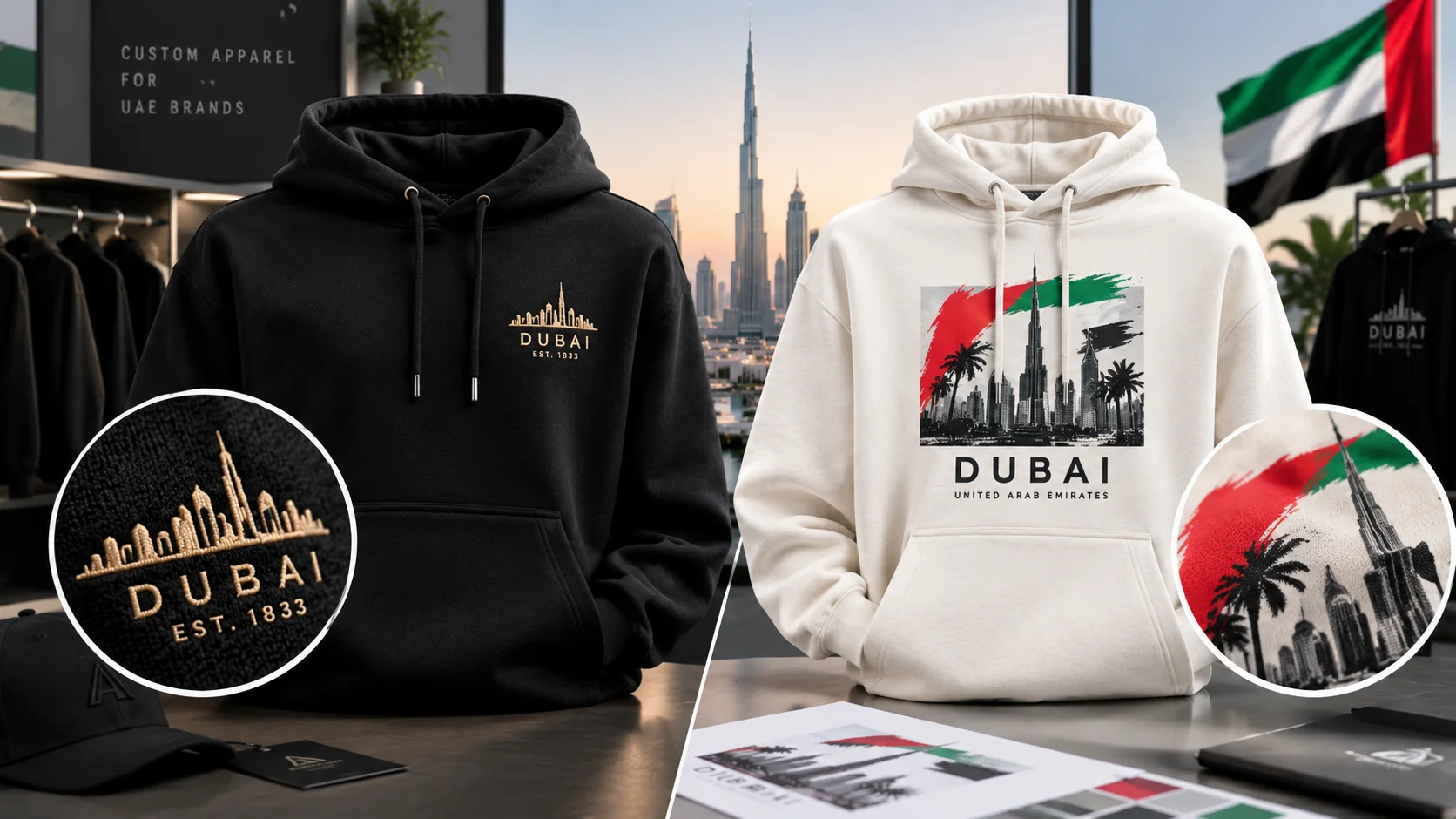
Here’s a mistake that happens more often than it should. A brand falls in love with its artwork, orders 200 hoodies, and only when the boxes arrive does it notice that the little tagline under the logo has turned into a blurry smudge of thread. Nobody did anything “wrong” exactly. The design just wasn’t suited to the method that was picked.
If you’re looking into custom graphic hoodies UAE customers will actually wear (and keep wearing), this guide is for you. We’ll talk about embroidery versus print in plain language, how the UAE climate and culture change the decisions, and why ordering a sample first is the cheapest insurance you’ll ever buy. No factory jargon, promise. By the end, Custom Graphic Hoodies for UAE Brands should feel like a decision you can make in one sitting.
The short answer for UAE brands
If you only have a minute, here it is.
Pick embroidery for small logos, staff hoodies and anything that gets washed every week. Pick screen print for big, bold graphics in a few solid colours, especially when you’re ordering in volume. Pick DTF print when the artwork has lots of colours, gradients or fine detail, or when you only want a small test run. And whichever you choose, approve a physical sample before bulk production starts. Colour and fabric feel can’t be judged from a screenshot, however good your monitor is.
That’s the whole story in four sentences. The rest of this article is the reasoning, so you can trust the answer instead of just taking our word for it.
Wait, do people really wear hoodies in the UAE?
They do, and more than you’d think.
Step into any mall, cinema or office tower in Dubai or Abu Dhabi and you’ll notice the air conditioning is set for people who’ve just walked in from 40 degrees. Plenty of residents keep a light layer in the car or the bag for exactly that reason. Add the cooler months, roughly November to March, plus desert camping, beach evenings and rooftop events, and a hoodie stops being a novelty and turns into a regular part of the wardrobe.
For brands, that’s useful. A hoodie gets worn weekly, photographed constantly and noticed by people who’ve never heard of you. Gyms, cafes, delivery startups, universities, creators and streetwear labels have all worked this out. The catch is that a hoodie only advertises you well if the print or stitching still looks sharp after months of washing.
Embroidery vs. print: what’s actually different?
Let’s strip it back to basics, because the names sound more complicated than the ideas.
Embroidery is a machine stitching thread straight into the hoodie. The design becomes part of the fabric. You can run a finger across it and feel the texture.
Screen printing pushes ink through a mesh stencil onto the garment. Every colour needs its own screen, so a one-colour logo is cheap to set up and a seven-colour illustration is not.
DTF (direct-to-film) printing prints the artwork onto a special film first, then heat-presses it onto the hoodie. There’s no separate screen for each colour, which is why it copes so well with detailed artwork.
Here’s how they compare side by side:
| Embroidery | Screen print | DTF print | |
| Looks like | Raised, textured, premium | Smooth, bold, classic | Sharp and colourful |
| Lasts | Longest of the three | Very well, if cured properly | Well, with decent film and care |
| Handles fine detail | Not great | Limited by colour count | Very well |
| Big back graphics | Heavy and expensive | Excellent | Excellent |
| Smaller runs | Fine | Set-up cost bites | Very flexible |
No method wins every time. The right one depends on your artwork, your quantity and the feeling you want the hoodie to give.
When embroidery is worth it
Embroidery says “this was made properly” before anyone reads the logo. It’s the go-to for staff and corporate hoodies, small chest logos, crests, monograms and short lines of text. Premium streetwear brands love it too, especially 3D puff embroidery, which gives letters a raised, chunky look.
The thing to watch is tiny details. Thread has thickness, so very thin lines and small lettering can clog up and look messy. A good manufacturer will tell you that and simplify the artwork for stitching instead of just running it and hoping.
When screen printing is worth it
Screen print is the workhorse of the hoodie world, and there’s a reason for that. It’s brilliant for large front and back graphics with a handful of solid colours: club hoodies, event merch, university orders, merch drops. The set-up cost gets spread across more pieces, so it tends to be the most economical option as quantities climb.
Where it struggles is gradients and photo-style images. Each extra colour means another screen, and the cost climbs fast.
When DTF is worth it
DTF is the answer for a lot of newer brands. Got an illustrated back graphic with ten colours and a soft gradient? Want to test 25 pieces before committing to 250? DTF was made for that. It also behaves well on darker and blended fabrics where other methods can be fussy.
The risk is cheap film or sloppy heat-pressing, which can leave a print that feels stiff or starts peeling early. Again, this is exactly what a sample is for.
So which one should you choose?
Match your situation to the closest one below.
You run a gym and need 50 hoodies for the team with a small logo on the chest? Go with embroidery. You’re launching a streetwear label with a big illustrated graphic across the back? Screen print if the art uses just a few colours, DTF if it’s colourful and detailed. You want 20 or 30 pieces to see how your audience reacts before ordering more? DTF again. You’d like a premium feel with some visual punch? Do what plenty of good brands do: embroider the chest logo and print the back.
And if none of those sound like you, that’s fine. Send us the artwork and we’ll tell you what we’d do, then prove it on a sample. You can request a free quote here and just mention your quantity and design.
What changes when your customers are in the UAE?
A good print on the wrong hoodie still disappoints. These are the local details worth thinking about before you place an order.
Fabric weight. A thick winter fleece is overkill for most of the year in the UAE. Mid-weight fleece or French terry usually feels right in air-conditioned spaces and mild winters. Save the heavier stuff for a premium cold-season drop. Ask for swatches or, better, hold a sample in your hands.
Colour. Black, off-white, sand, olive, navy and washed grey keep selling because they look good in strong sunlight and on camera. Very light colours show marks quickly, so test before you commit.
Arabic and bilingual artwork. Arabic runs right to left and its letters connect, which makes tiny embroidered script risky. Keep Arabic text bigger, or print it if the calligraphy is fine. Whatever you do, have a native reader check the sample. A flipped or broken letter on a finished hoodie is painful to fix.
Timing. National Day, Ramadan and Eid campaigns, back-to-school and the cooler months are the natural launch windows. Count backwards from your date and leave breathing room for sampling and shipping.
Fit. Relaxed and oversized cuts dominate in streetwear, while corporate teams usually want something cleaner. Share a size chart or a hoodie you already love, and the factory can match it.
The sample-first process (and why it saves you money)
Most people think of a sample as a delay. It’s the opposite. A sample is where small, cheap mistakes get found before they become big, expensive ones. Here’s how ordering Custom Graphic Hoodies for UAE Brands works with us at JACX Wears:
- You send the idea. A logo, a sketch, a finished design or a hoodie you want copied. No tech pack? We can build one from your sketches.
- We recommend a method. Embroidery, screen print or DTF, based on your artwork, fabric and quantity.
- You choose fabric and trims. Colour, weight, labels, hangtags and packaging.
- We make your pre-production sample. This usually takes 3 to 5 business days.
- You check it properly. Fit, fabric feel, colour, placement, stitch or print quality. Ask for changes if something’s off.
- You approve, and bulk begins. Bulk production typically takes about 24 days after sample approval, depending on quantity and how much decoration is involved.
- We inspect and ship. Every order gets in-line checks during stitching and a final AQL 2.5 inspection before it leaves the factory.
Our ordering guidelines go into more detail. And since the minimum is just 20 pieces per style, testing a new design doesn’t mean betting the whole budget.
What to look for when the sample arrives
Don’t just glance at it and say “looks good.” Put it on. Take it outside and look at it in daylight, because indoor lighting flatters everything. Then run through these questions. Does the colour match your brand colour? Is the embroidery flat and clean, without puckering around the edges? Does the print feel smooth, and does it hold when you stretch and rub it? Is the design centred and at the right height? Does the fit match the size you asked for? Does the fabric feel right for the price you plan to charge?
If any answer is “not quite”, say so now. Fixing it at the sample stage costs almost nothing. Fixing it after 300 hoodies are made costs a lot.
Mistakes we’d love you to avoid
Skipping the sample is the big one, and we’ve covered it. After that, the most common problems are fairly predictable.
Using the wrong method for the artwork comes next. Fine detail embroidered at a small size, or a gradient forced into screen print, rarely ends well. Then there’s choosing the cheapest blank hoodie. A strong graphic on a thin, badly cut hoodie still feels cheap, and customers can tell the moment they pick it up.
Low-resolution artwork is another culprit. A blurry file makes a blurry print, so send vector files (AI, EPS, SVG or a high-resolution PDF) whenever you can. And don’t forget aftercare. Tell your customers to wash the hoodie inside out in cool water. It makes any decoration last longer, and it costs you nothing to print on a care label.
Last one: starting too late. Sampling, approval, production and shipping all take time. A launch date three weeks away is a stressful launch date.
What actually decides the price?
You’ll see wildly different prices online, which is confusing. These are the things that move the number most.
Quantity matters, because per-piece cost usually falls as you order more, especially with screen printing. The method matters too: embroidery cost depends on stitch count, screen print on how many colours and placements you use, and DTF mostly on print size. More placements (chest plus back plus sleeve) cost more than one chest logo. Fabric weight and quality change things, and so do extras like woven labels, neck tags, hangtags and branded packaging. Those extras add to the total, but they also make your hoodie feel like a real brand and not a blank with a logo on it.
The easiest way to get an honest number is a quote based on your real design and quantity.
Selling into the UAE from the US or Europe?
If you’re a US or European brand opening in the Gulf, or you’re shipping merch to Dubai or Abu Dhabi, nothing in this guide changes much. Choose a sensible fabric weight for the climate, test any Arabic or bilingual artwork on a sample, and pick a decoration method that survives frequent washing. It also helps to work with a factory that’s already used to US, UK and EU tech packs, size standards and private label requirements, because it cuts a lot of back-and-forth.
Why brands pick JACX Wears for Custom Graphic Hoodies for UAE Brands
We’re a custom apparel manufacturer in Sialkot, Pakistan, with ISO 9001-certified quality processes. We work directly with brands, with no middlemen in between, so you’re talking to the people who actually make your hoodies.
In practice, that means a low minimum of 20 pieces per style, in-house embroidery, screen printing, DTF, sublimation, embossing and silicone printing, pre-production samples in 3 to 5 business days, and full private label options including woven labels, neck tags, hangtags and custom packaging. We ship worldwide with DHL, FedEx and UPS. Tell us your UAE delivery address when you ask for a quote and we’ll confirm the shipping terms with you.
Have a look at our men’s hoodies and women’s hoodies, or take a tour of the factory to see how your order will be made.
Ready to test your design? Get your free quote and sample plan.
Questions people ask us
What’s the best option for a small brand ordering custom graphic hoodies in the UAE?
Start small and keep it simple. A mid-weight hoodie, a bold graphic in one to three colours, and a run of 20 to 50 pieces is a sensible first order. Use screen print for simple art, DTF for detailed art, and add an embroidered chest logo if you want a more premium feel.
Is embroidery or print better for hoodies?
Embroidery is better for small logos and the longest-lasting, most premium look. Print, whether screen or DTF, is better for large, colourful graphics. Lots of brands use both on the same hoodie.
What’s the minimum order?
At JACX Wears it’s 20 pieces per style. Larger orders get volume-based pricing, so it’s worth asking for a tiered quote.
How long does it take?
A pre-production sample usually takes 3 to 5 business days. Bulk production is typically about 24 days after you approve the sample, depending on quantity and decoration. Shipping time comes on top and depends on your destination.
Do I really need a sample first?
Yes, honestly. It lets you check colour, fit, fabric feel and quality before you commit. It’s the cheapest protection in the whole process.
Can you add my own labels and packaging?
Yes. We offer custom woven neck labels, care tags, hangtags, heat-transfer inner logos and branded polybags as part of our private label service.
Will the design survive washing?
Embroidery is the toughest. Properly cured screen print and good-quality DTF also hold up well if the hoodie is washed inside out in cool water and not over-dried. Your sample is the best test of all.
Before you place that first order
The brands that do well with custom graphic hoodies UAE shoppers love aren’t always the ones with the biggest budgets. They’re the ones that matched the right method to the right design, tested it on a real sample and only then scaled up.
So, a quick reminder. Embroidery suits small, premium, long-wearing logos. Screen print suits bold graphics at volume. DTF suits detailed, colourful artwork and smaller runs. And a sample comes first, every time.
If you’re planning Custom Graphic Hoodies for UAE Brands, send us your artwork, your quantity and your launch date. We’ll suggest the best method, make your sample and walk you through bulk production.
Request your free quote now or message us on WhatsApp and let’s get your sample started.