
If you’ve ever tried to start a clothing brand, you already know the real work doesn’t happen in Photoshop or on a mood board. It happens on a factory floor, surrounded by machines you’ve probably never heard of, and each one decides whether your final product looks like a $5 thrift find or a $50 premium piece.
That’s the part nobody talks about enough. People obsess over fabric quality, sustainability, and branding, but the actual apparel manufacturing equipment used to build a garment is what separates a clean, market-ready product from something that falls apart after two washes.
In this guide, we’re breaking down everything you need to know about apparel manufacturing equipment from the first pattern cutter that touches your fabric to the fusing press that finishes it. We’ll walk through the different types of garment machinery, explain what each machine actually does, and help you understand what to look for whether you’re setting up a factory, sourcing a manufacturer, or just trying to understand what happens before your hoodie shows up at your door.
And since this is coming from a working apparel manufacturer, not a textbook, we’ll keep it practical the kind of information you’d actually use to make a decision.
Why Understanding Apparel Manufacturing Equipment Actually Matters
Let’s be honest, most people starting a clothing line don’t care about machines. They care about the finished product. But here’s the thing: you can’t separate the two.
The right apparel manufacturing equipment affects:
- Stitch quality and durability: how well the garment survives repeated washing and wear
- Production speed: how fast a factory can turn your order around
- Consistency: whether size Medium #1 looks identical to size Medium #500
- Cost per unit: automated machinery reduces labor time, which affects your final price
- Design possibilities: some finishes, like sublimation printing or pleating, are only possible with specific equipment
If you’re sourcing a manufacturer, knowing this equipment helps you ask smarter questions. If you’re building your own facility, it helps you avoid buying machines you don’t actually need. Either way, understanding the types of garment machinery used in production puts you in a much stronger position.
The Apparel Manufacturing Process, Step by Step
Before we get into individual machines, it helps to see the bigger picture. A typical apparel production line moves through these stages:
- Design and pattern making: turning a sketch into a wearable pattern
- Fabric inspection and spreading: checking quality and laying fabric for cutting
- Cutting: cutting fabric into the exact pattern pieces
- Sewing and assembly: stitching all the pieces together
- Embellishment: embroidery, printing, or sublimation
- Pressing and finishing: fusing, pleating, ironing
- Quality control and packaging: final inspection before shipping
Each of these stages relies on a different category of apparel manufacturing equipment, and that’s what we’ll cover next.
Types of Garment Machinery: The Complete Breakdown
This is the core of it. When people ask about types of garment machinery, they’re usually thinking of sewing machines, but a real production floor uses dozens of different machine categories working together. Here’s a full breakdown by stage.
1. Pattern Cutters and Pattern-Making Tools
Everything starts here. Pattern cutters translate a design into a physical or digital template that determines the exact shape of every fabric piece.
- Manual pattern cutting tools: used by skilled pattern masters for custom or sample work, especially useful for small-batch or made-to-order pieces
- CAD (Computer-Aided Design) pattern software: digitizes patterns for grading (resizing across a size range) and reduces human error
- Plotters: print the final graded patterns onto paper or card for the cutting room
A factory that invests in proper pattern cutters and CAD systems can grade a design across ten sizes in a fraction of the time it takes to do it by hand, and more importantly, with far more accuracy. If your manufacturer is still eyeballing size grading, that’s usually a red flag for consistency issues down the line.
2. Cutting Machines
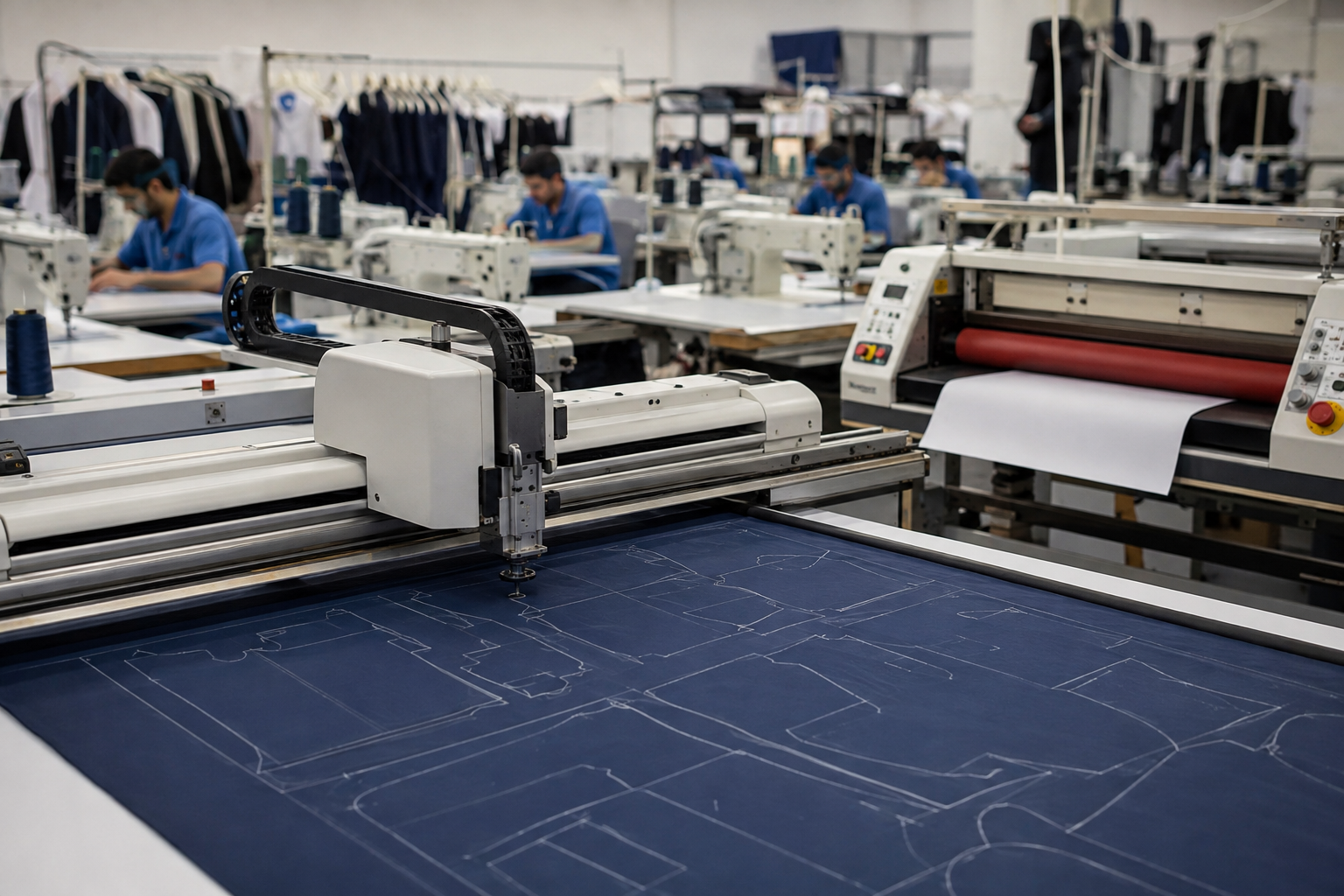
Once the pattern is ready, fabric needs to be cut, and this is one of the most important categories of apparel manufacturing equipment because a single mistake here can waste an entire fabric roll.
Common cutting machines include:
- Straight knife cutters: handheld, flexible, used for multi-layer fabric spreads
- Round knife cutters: good for straight-line cuts on thinner spreads
- Band knife machines: stationary, used for precision cutting of pattern pieces
- Die-cutting machines: use metal dies to punch out repeated shapes quickly, common for smaller components like collars and cuffs
- CNC/automated fabric cutters: computer-guided cutting that minimizes fabric waste and increases precision, increasingly common in mid-to-large factories
Fabric waste is a real cost issue in this industry, and this is exactly where good cutting machines pay for themselves. A factory using automated cutting can often save a meaningful percentage of fabric per order compared to manual cutting, which adds up fast across bulk production runs.
3. Industrial Sewing Machines
This is the heart of any garment factory, and probably the piece of apparel manufacturing equipment most people already picture when they think “clothing factory.” But there isn’t just one type of industrial sewing machine; there are dozens, each built for a specific job.
Some of the most common industrial sewing machines include:
- Single needle lockstitch machines: the workhorse machine for general seams
- Overlock (serger) machines: trim and finish raw edges to prevent fraying
- Flatlock machines: used for activewear and knitwear seams that need to lie flat against the skin
- Chain stitch machines: create a durable, slightly elastic stitch, often used on denim
- Buttonhole and button-attaching machines: automate two of the most repetitive tasks in shirt-making
- Bar tacking machines: reinforce stress points like pocket corners and belt loops
- Zigzag machines: used for stretch seams and decorative stitching
A factory’s sewing floor usually has far more machines than any other section, simply because sewing is the most labor-intensive part of the process. The quality, maintenance, and skill level behind these industrial sewing machines is honestly one of the biggest factors in whether a garment holds up over time.
4. Embroidery Equipment
If your brand relies on logos, custom text, or detailed designs stitched directly into fabric, this is where it happens.
Modern embroidery equipment typically includes:
- Single-head embroidery machines: best for samples and small runs
- Multi-head embroidery machines: allow a factory to stitch the same design onto multiple garments simultaneously, ideal for bulk orders
- Computerized embroidery machines: digitize artwork into stitch files, giving precise control over thread density, color changes, and design placement
Good embroidery equipment doesn’t just add branding; it adds perceived value. A clean, well-digitized embroidered logo instantly reads as more premium than a printed one, which is why so many streetwear and workwear brands lean on it heavily.
5. Sublimation Heat Press Equipment
This is where a lot of modern, design-heavy apparel think all-over print activewear, custom jerseys, or vibrant graphic tees- actually comes to life.
A sublimation heat press works by transferring dye from a printed sheet onto polyester or polyester-blend fabric using heat and pressure, permanently bonding the design into the fibers rather than sitting on top of them. This is different from screen printing or DTG (direct-to-garment) printing, and it comes with real advantages:
- The print never cracks, peels, or fades from washing, since the ink becomes part of the fabric
- It supports full, edge-to-edge, all-over designs, not just a printed square on the chest
- It’s cost-efficient for vibrant, multi-color designs compared to multi-screen printing
The catch is that a sublimation heat press only works well on polyester or high-poly blends, so it’s not a fit for every fabric type. If your brand is built around all-over print streetwear, activewear, or sportswear, this is one machine your manufacturer absolutely needs to have and know how to run properly.
6. Pleating Machinery
Pleats are one of those details that look simple but are genuinely difficult to get right by hand, which is exactly why pleating machinery exists.
- Manual pleating boards: used for smaller batches or couture-level work
- Automated pleating machines: heat-set pleats into fabric using pressure and temperature, locking the shape in permanently
- Accordion and knife pleat machines: used for specific pleat styles common in skirts, formalwear, and uniforms
Once fabric goes through proper pleating machinery, the pleats are heat-fixed and hold their shape wash after wash, instead of falling flat the first time you sit down, which is what happens with hand-pressed pleats that were never truly set.
7. Fusing Machines
Fusing is one of those invisible processes that most customers never think about, but you’d absolutely notice if it were missing. It’s what gives collars, cuffs, waistbands, and plackets their structure instead of feeling floppy or shapeless.
A fusing machine applies heat and pressure to bond an interlining (a stiff, adhesive-backed fabric layer) to the main fabric. This is common on:
- Shirt collars and cuffs
- Waistbands
- Jacket lapels
- Pocket flaps
Without proper fusing equipment, these areas either need heavy hand-stitching (expensive and inconsistent) or end up looking limp and unfinished. A good fusing machine applies even heat and pressure across the entire piece, which is something you genuinely cannot replicate with a household iron, no matter how careful you are.
8. Finishing and Quality Control Equipment
Once a garment is fully assembled, it still isn’t done. Finishing equipment includes:
- Steam presses and ironing tables: remove wrinkles and give garments their final shape
- Fabric inspection machines: scan for defects before cutting begins
- Metal detectors: standard in factories producing garments for children or export markets, to catch stray needles
- Tensile and pull testers: check seam and fabric strength before bulk approval
These machines don’t get much attention, but they’re the last checkpoint before a garment reaches your customer, and skipping this stage is exactly how defective units slip into a shipment.
How to Choose the Right Apparel Manufacturing Equipment (Or the Right Manufacturer)
If you’re setting up your own facility, here’s what actually matters when evaluating apparel manufacturing equipment:
- Match the machine to your product: a streetwear brand doing all-over prints needs a strong sublimation setup; a formalwear brand needs solid pleating machinery and fusing presses
- Think about order volume: multi-head embroidery machines and automated cutters make sense at scale, but might be overkill for small-batch production
- Don’t ignore maintenance costs: industrial sewing machines and cutting equipment need regular servicing; factor that into your budget
- Check for skilled operators, not just machines: a $50,000 embroidery machine is only as good as the person running it
If you’re sourcing rather than building, the smarter move is usually to work with a manufacturer who already owns the full range of this apparel manufacturing equipment so you’re not juggling five different vendors for cutting, sewing, embroidery, and finishing.
This is actually the exact gap JACX Wears was built to close. As a custom clothing manufacturer based in Sialkot, Pakistan, JACX Wears runs its own in-house design, fabric production, cutting, sewing, embroidery, printing, and packaging departments, meaning your product moves through one connected process instead of getting passed between disconnected suppliers. If you’re building a brand and want a manufacturing partner who actually understands this equipment (not just talks about it), get in touch with JACX Wears for a free consultation on your next production run.
Frequently Asked Questions
What is included in an apparel manufacturing equipment list?
A standard list covers pattern-making tools and CAD software, cutting machines (straight knife, round knife, band knife, CNC cutters), industrial sewing machines (lockstitch, overlock, flatlock, bartack), embroidery equipment, sublimation heat presses, pleating machinery, fusing machines, and finishing tools like steam presses and inspection equipment. The exact list depends on the type of garments being produced.
What is the price range for garments machinery?
Prices vary hugely depending on automation level and brand origin. A basic single-needle lockstitch machine can start around $150–$400, while automated cutting systems, multi-head embroidery machines, and industrial fusing presses can run into the thousands or tens of thousands of dollars. Most factories build their machine fleet gradually rather than buying everything upfront.
Where can I find a garments machinery list PDF?
Several industry resources and textile-focused sites publish downloadable machinery lists with specifications, though prices and models change often, so it’s worth cross-checking with a current supplier or manufacturer before making purchasing decisions.
How many types of sewing machines are used in the apparel industry?
Depending on how you categorize them, the industry commonly references around 20 different types of industrial sewing machines, including lockstitch, overlock, flatlock, chain stitch, buttonhole, bar tack, zigzag, blind stitch, and various specialty attachment machines like pocket setters and cuff setters.
What does an automatic pocket setter machine do?
An automatic pocket setter folds, positions, and stitches pockets onto garments like jeans, shirts, and uniforms in a single automated cycle. It significantly speeds up production and creates far more consistent pocket placement than manual sewing, which is especially important for brands producing in bulk.
What’s the difference between an industrial sewing machine and a regular sewing machine?
Industrial sewing machines are built for continuous, high-speed operation; they run faster, handle thicker fabric layers, and are designed for one specific stitch type rather than the multi-function approach of a home sewing machine. This is what allows factories to maintain speed and consistency across thousands of units.
Final Thoughts
Apparel manufacturing equipment isn’t the most glamorous part of the fashion industry, but it’s the part that actually determines whether your product succeeds or gets returned. From the first pattern cutter to the final fusing press, every machine on this list plays a role in the quality your customer feels when they put your garment on.
If you’re building a clothing brand and want a manufacturing partner that handles the full process design, fabric, cutting, sewing, embroidery, printing, and packaging under one roof, JACX Wears is ready to help you bring it to life. Reach out today and let’s talk about your next production run.