
Table of Contents
Picture this: your team’s about to walk onto the field for the first time this season, and instead of looking like a unit, half the jerseys look slightly off — colors don’t quite match the mockup, the numbers look cramped, and someone’s name is peeling off after two washes. It happens more than you’d think, and almost always it comes down to one thing: nobody actually planned the baseball uniform design properly before hitting “order.”
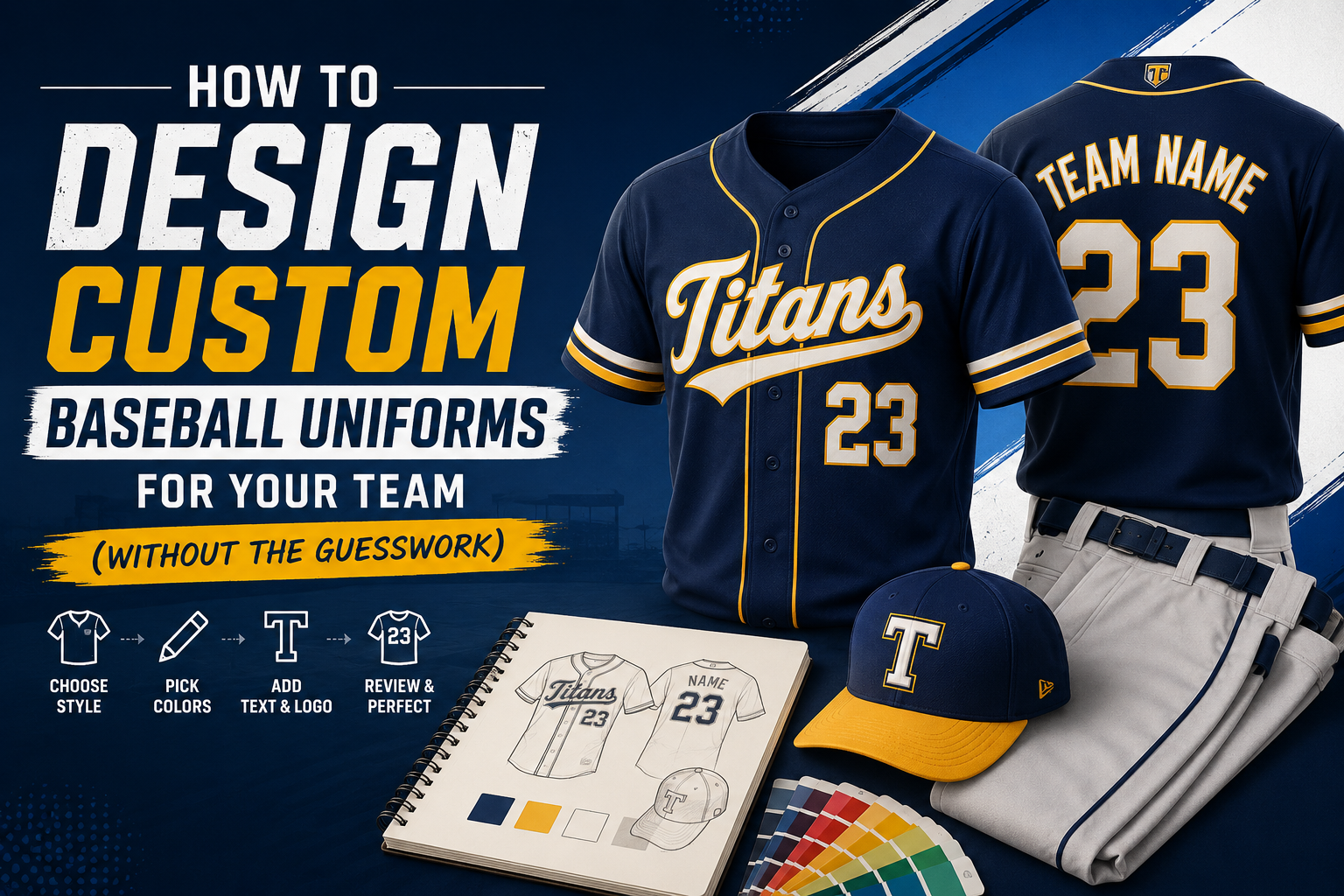
Designing a custom baseball uniform isn’t complicated, but it does have a few moving parts that are easy to get wrong if you’re doing it for the first time. This guide walks through exactly how to do it right — from picking colors to choosing fabric to actually placing the order — so your team ends up looking like it means business. If you want to see finished examples while you read, our baseball uniforms collection is worth a look for reference.
Why the Design Stage Actually Matters More Than People Think
A lot of teams treat the design step like it’s just picking a color and slapping a logo on. But your baseball uniform is doing more work than you’d expect. It’s part of team identity, it affects how players move and perform on the field, and — whether anyone admits it or not — it affects confidence. A team that looks sharp tends to carry itself differently than one that looks thrown together.
Getting the baseball uniform design right the first time also just saves you money and headaches. Reordering because sizing was off, colors didn’t match, or the fabric felt wrong in the heat is expensive and slow. Better to get it right at the design stage than fix it after 20 jerseys have already been printed.
There’s also a practical side to this that’s easy to overlook: a well-planned design process is usually faster overall, not slower. Teams that skip planning and jump straight to placing an order often end up going back and forth on revisions after the fact — tweaking colors, resizing logos, redoing mockups — which stretches the timeline out far more than if those decisions had been made properly upfront. A bit of structure at the start genuinely saves time by the end.
Step 1: Nail Down Your Team Colors and Identity First
Before you even think about jersey style, lock in your actual team colors — and be specific. “Blue” isn’t a colour, it’s a category. Work in exact colour codes (Pantone or hex) so whoever’s producing your uniforms matches it precisely, rather than guessing at “sort of navy.”
If your team already has a logo, your uniform colors should pull directly from it, not just loosely relate to it. If you’re designing a logo and uniform at the same time, pick two to three core colors max — baseball uniforms that try to use five different colors usually end up looking busy rather than sharp.
Step 2: Pick the Right Baseball Jersey Style for Your Team
Not every team needs the same cut. A few common styles worth knowing:
Button-down jerseys — the classic, traditional baseball look. Slightly more formal, popular with high school and college programs.
Pullover jerseys — no buttons, easier and cheaper to produce, common for youth leagues and rec teams.
Full-sublimation jerseys — the design is dyed directly into the fabric rather than printed on top, meaning it never peels, cracks, or fades, and you can use unlimited colors and gradients without extra cost. This is the standard for most modern custom baseball jerseys now, especially for teams that want bold, unique baseball jersey design elements like fades, patterns, or textures.
If durability and design freedom matter to you, full sublimation is worth the small extra step in production time — it holds up far better over a full season than screen printing or vinyl transfer. It’s the same process we use across our own sports uniforms range, not just for baseball.
Step 3: Think About Fabric Before Anything Else
This is the part a lot of teams skip entirely, and it’s genuinely one of the most important calls. Baseball is a summer sport in a lot of leagues, which means your baseball shirts need to actually perform in heat and movement, not just look good in a mockup.
Look for:
- Moisture-wicking polyester — pulls sweat away from the body instead of soaking it up
- Breathable mesh panels — especially under the arms and along the sides, where airflow matters most
- Enough stretch — pitchers and fielders need a full range of motion without the fabric fighting them
A jersey that looks great but feels stiff or traps heat is a jersey players will complain about by the third inning. Fabric choice is where “looks good” and “works well” either come together or fall apart.
Step 4: Get Names, Numbers, and Sponsor Logos Right
This sounds simple but trips teams up constantly. A few things to nail down early:
- Font consistency — every player’s name and number should use the same font, size, and placement, not whatever looked good on one sample.
- Number placement — standard is front chest (smaller) and back (larger), but confirm sizing works across your full size range, from the smallest kid on the team to your tallest player.
- Sponsor logos — if your uniform includes sponsor branding, decide placement (usually sleeve or chest) before finalizing the rest of the baseball uniform design, since it affects how much space you have left for everything else.
Get a full roster with correct name spellings and numbers locked in before production starts. Reprinting one jersey because a name was misspelled is an annoying, avoidable delay.
Step 5: Use a Mockup Before You Commit to Anything
Never approve a full baseball uniform design based on a rough sketch or a verbal description alone. A proper baseball uniform mockup — ideally a realistic 3D mockup showing the jersey on an actual body shape, front and back — lets you catch problems before they’re permanent: colors that look different on fabric than on screen, logos that are too small, proportions that feel off.
A lot of teams searching for a baseball jersey designer free online end up with a flat, 2D template that doesn’t actually show how the design will look once it’s on fabric and worn by a real player. A proper 3D mockup solves that — it’s the closest thing to seeing the finished jersey before it’s actually made, and it’s worth insisting on one before you approve a bulk order.
Step 6: Decide Between a Full Uniform Kit or Jersey-Only
A full baseball kit typically includes the jersey, pants, and cap, sometimes a belt too. Some teams — especially rec leagues or teams on a tighter budget — go jersey-only and let players sort their own pants. If you’re doing a full kit, make sure pants and cap colors are chosen alongside the jersey, not as an afterthought, since mismatched shades between separately-ordered pieces are a common and avoidable mistake. If you’d rather browse finished styles than start from a blank page, our caps and pants collections are a good starting point for matching pieces.
Designing for Youth Teams vs Adult and Competitive Teams
The design priorities shift quite a bit depending on who’s actually wearing the uniform, and it’s worth thinking through separately rather than assuming one approach fits every age group.
Youth baseball uniforms need a bit more flexibility built in. Kids grow fast, sizes vary wildly even within the same age group, and budgets for youth leagues are often tighter than for high school or club programs. A simpler pullover jersey design, a slightly more forgiving fit, and durable fabric that survives a season of a nine-year-old sliding into second base matters more here than intricate design details.
High school and college programs usually want a more polished, traditional look — button-down jerseys, more structured fits, and design elements that reflect school branding precisely, since these uniforms often represent the institution as much as the team.
Travel and competitive club teams tend to push design further, since these teams are often trying to stand out at tournaments and build a distinct identity. This is where full-sublimation designs with gradients, unique patterns, and bold colorways tend to show up most, since there’s more design freedom (and usually more budget) to work with.
Knowing which category your team falls into before you start designing saves a lot of back-and-forth later, since it shapes almost every decision from fabric weight to how adventurous the colour palette can be.
Budget Planning: What Actually Drives Baseball Uniform Cost
A big part of baseball uniform design is knowing where your budget is actually going, so you’re not surprised later. A few things that move the price:
Customisation level — a simple two-colour design with basic numbering costs less than a full-sublimation jersey with gradients, patterns, and multiple logo placements.
Order quantity — like most custom apparel, per-unit cost drops as your total order size goes up, so ordering for the full roster at once (rather than trickling in orders) usually works out cheaper per jersey.
Full kit vs jersey-only — obviously a complete kit (jersey, pants, cap, belt) costs more than a jersey alone, but it also gives you a more consistent, professional look across the whole team.
Fabric quality — a heavier, more technical performance fabric costs more than a basic polyester blend, but tends to last through more seasons without pilling, fading, or losing shape.
It’s worth asking for an itemised quote rather than one bundled number, so you can see exactly where your budget is going and adjust — maybe simplifying the design slightly to afford better fabric, for instance, rather than the other way around. Our why choose us page covers how we structure pricing for teams working with different budgets and order sizes.
Baseball Uniform Design Trends Worth Knowing About
Design trends shift a bit year to year, and while you don’t need to chase every trend, it’s worth knowing what’s currently popular so your team doesn’t end up looking dated the moment the season starts.
Gradient and fade effects have become a lot more common, largely because full-sublimation printing makes them easy and affordable to produce, where they used to require expensive specialty printing.
Retro and vintage-inspired designs — think classic serif fonts, simpler two-tone colour schemes — have made a strong comeback, partly as a reaction to overly busy, graphic-heavy designs from a few years back.
Textured patterns within the fabric itself (subtle camo, marble, or geometric patterns worked into the base colour rather than printed on top) are showing up more in competitive and travel team uniforms specifically.
Alternate jerseys — a second, distinct uniform design worn for specific games or tournaments — have become common even at the high school level, not just professional teams, as an added way to build team identity and give players something to look forward to.
None of these are required for a good baseball uniform design, but they’re useful to know about so you can make an informed choice rather than defaulting to whatever the first template you’re shown looks like.
Taking Care of Your Custom Baseball Uniforms Once They Arrive
A good design and good fabric only pay off if the uniforms actually last the season. A few basics that extend the life of a custom baseball uniform:
- Wash in cold water and avoid high heat in the dryer, which can weaken sublimated colors and stretch out performance fabric over time
- Turn jerseys inside out before washing to reduce friction on printed numbers, names, and logos
- Treat grass and dirt stains promptly rather than letting them set — baseball uniforms take a beating, and quick treatment makes a real difference over a full season
- Avoid ironing directly on sublimated designs, since heat can affect the print if applied directly rather than through a protective cloth
Teams that take care of their uniforms properly often get a second season of decent wear out of them, which matters if the budget is tight and you’re not planning to redesign every year.
Common Mistakes Teams Make When Designing Baseball Uniforms
Skipping the mockup stage. Approving a design from a flat sketch instead of seeing it rendered on an actual jersey shape almost always leads to surprises.
Choosing fabric last instead of first. A great-looking design on the wrong fabric still performs badly on the field.
Not confirming sizes across the whole roster. A design that looks balanced on a medium jersey can look completely different stretched across an XXL.
Overcomplicating the colour palette. More colors doesn’t mean a better-looking uniform — it usually just means a busier one. A tight two or three-colour palette almost always reads as more professional than a design trying to use every colour in the logo.
Ignoring the away/road uniform. Plenty of teams design a sharp home uniform and treat the away version as an afterthought — same design, colors just swapped. It’s worth giving the road uniform a proper look too, since it gets just as much game time as the home kit.
Not locking in the roster before production. Late name or number changes slow everything down and can lead to costly reprints.
How the Design Process Actually Works With JacxWears
At JacxWears, designing a custom baseball uniform starts with your team colors, logo, and any reference designs you like — even just a photo of a uniform style you want to riff on is enough to get started. From there, our in-house design team builds out your baseball jersey design, including a realistic mockup so you can see exactly how it’ll look before a single piece of fabric is cut. If your team also needs matching off-field gear, our casual wear range covers hoodies, tracksuits, and t-shirts that can be branded to match your uniform.
Once you approve the design, we move to fabric selection — matching the right weight and weave to your climate and how competitive your season is — and then into sampling before full production, so nothing about your custom baseball uniform is a surprise once the full order arrives. Whether you’re outfitting a youth rec team on a modest budget or a competitive travel squad wanting a distinctive look for tournament season, the same process applies: design first, confirm it, then produce it — never the other way around.
Frequently Asked Questions
Can I design a baseball uniform online before ordering?
Yes — most manufacturers, including JacxWears, let you start with your team colors, logo, and reference images, then build out a full baseball uniform design digitally, complete with a mockup, before anything goes to production. You don’t need design software experience to do this; sending a rough idea is enough to start.
Is there a standard baseball uniform pattern I should follow?
There’s a traditional structure most teams follow — button-down or pullover jersey, matching pants, a cap, and sometimes a belt — but the actual pattern (fit, cut, panel placement) can be fully customized to your team’s preferences and body types. It’s less about following one fixed template and more about adapting a proven structure to fit your team, your budget, and the level of competition you’re playing at.
Are there free baseball jersey designer tools available?
Some manufacturers offer free design consultations or basic online tools as part of their service, meaning you don’t pay separately just to see design concepts. It’s worth asking upfront whether design work is included in your uniform order, since many manufacturers bundle it in rather than charging as a separate service.
What’s the difference between a baseball jersey design and a baseball jersey t-shirt design?
A baseball jersey design usually refers to the full performance uniform top — built from technical fabric, sized for athletic movement, with names and numbers. A baseball jersey t-shirt design is typically a more casual, cotton-based shirt styled to look like a jersey, often used for fan merchandise or team spirit wear rather than actual game-day performance apparel.
Why does a baseball uniform mockup matter so much?
Because it’s the only reliable way to catch a design problem before it’s permanent. A mockup shows you how colors, logos, and proportions actually look on the finished shape of a jersey, rather than leaving it to guesswork based on a flat sketch or description.
What’s the benefit of a 3D mockup over a regular flat design?
A 3D mockup shows your baseball uniform design on an actual body shape, front and back, which gives a far more accurate sense of how everything will look once it’s worn — proportions, placement, and how colors and patterns wrap around the fit. A flat, 2D template can’t show you that, and it’s the difference between hoping a design works and actually knowing it does before a single jersey is produced.
How long does it take to go from design to finished baseball uniforms?
This varies by manufacturer and order size, but a realistic timeline usually includes mockup approval, a physical sample for fit and quality confirmation, then bulk production. Ask for a specific timeline based on your actual order rather than a generic estimate that might not reflect your team’s size or customisation level — a simple two-colour design will naturally move faster than a heavily customised, multi-piece kit.
Can sponsor logos be added to a custom baseball uniform design?
Yes, sponsor logos are commonly added to sleeves or the chest area of baseball uniforms. It’s best to decide on sponsor placement early in the design process, since it affects how much space is available for team branding, names, and numbers. Some leagues also have specific rules about sponsor logo size and placement, so it’s worth checking your league’s guidelines before finalising the design.
Ready to Design Your Team’s Baseball Uniforms?
At JacxWears, we handle every part of the process in-house — design, mockups, sampling, and production — so your custom baseball uniforms turn out exactly the way your team pictured them, not a rough approximation of it. Send us your colors, logo, and any reference designs, and we’ll put together a mockup before you commit to anything.