


Table of Contents
A few years back, I watched a mid-season high school game where one team’s jerseys had already started going see-through at the shoulders. Numbers peeling. Colors that looked gray instead of navy under the lights. Nobody said anything out loud, but you could see it in how the kids carried themselves — a little smaller, a little less sure of themselves. Meanwhile, the team across the field looked like they’d stepped out of a catalog, and honestly, they played like it too.
That’s not a coincidence, and it’s not really about vanity either. An American football uniform design that’s actually done right changes how a team shows up — literally and mentally. This guide isn’t going to throw buzzwords at you. It’s what I’d tell a coach or an athletic director sitting across the table trying to figure out what to order before the season starts.
Does the Design Really Matter That Much?
Short answer — yes, more than most people expect. There’s a reason college programs spend real money on uniform reveals every year. When players feel sharp, they play looser and more confident. It’s not magic; it’s just how people work. Put a kid in something that fits well and looks intentional, and he stands a little taller as he walks off the bus.
But there’s a boring, practical reason too, and it’s honestly the one that should matter most to whoever’s holding the budget. Football is brutal on gear. Grass, sweat, tackles, three practices a week for months. A cheap American football uniform starts falling apart by October — seams give out, fabric thins at the knees, colors wash out after a few cycles in the laundry. A properly built one survives the whole season, and the one after that too. So really, good design is just good math.
What You’re Actually Working With
Before getting into decisions, it’s worth laying out what a full kit even includes, because most of the design energy — and most of the money — goes into two of these pieces specifically.
A standard set covers the jersey, the pants, helmet and shell, shoulder pads with the undergarments worn beneath them, and then socks and cleats to round it out. The helmet’s mostly a safety and branding decision handled separately. The jersey and pants are where the actual design work happens, so that’s where we’ll spend most of this guide.
The Jersey Is Where First Impressions Happen
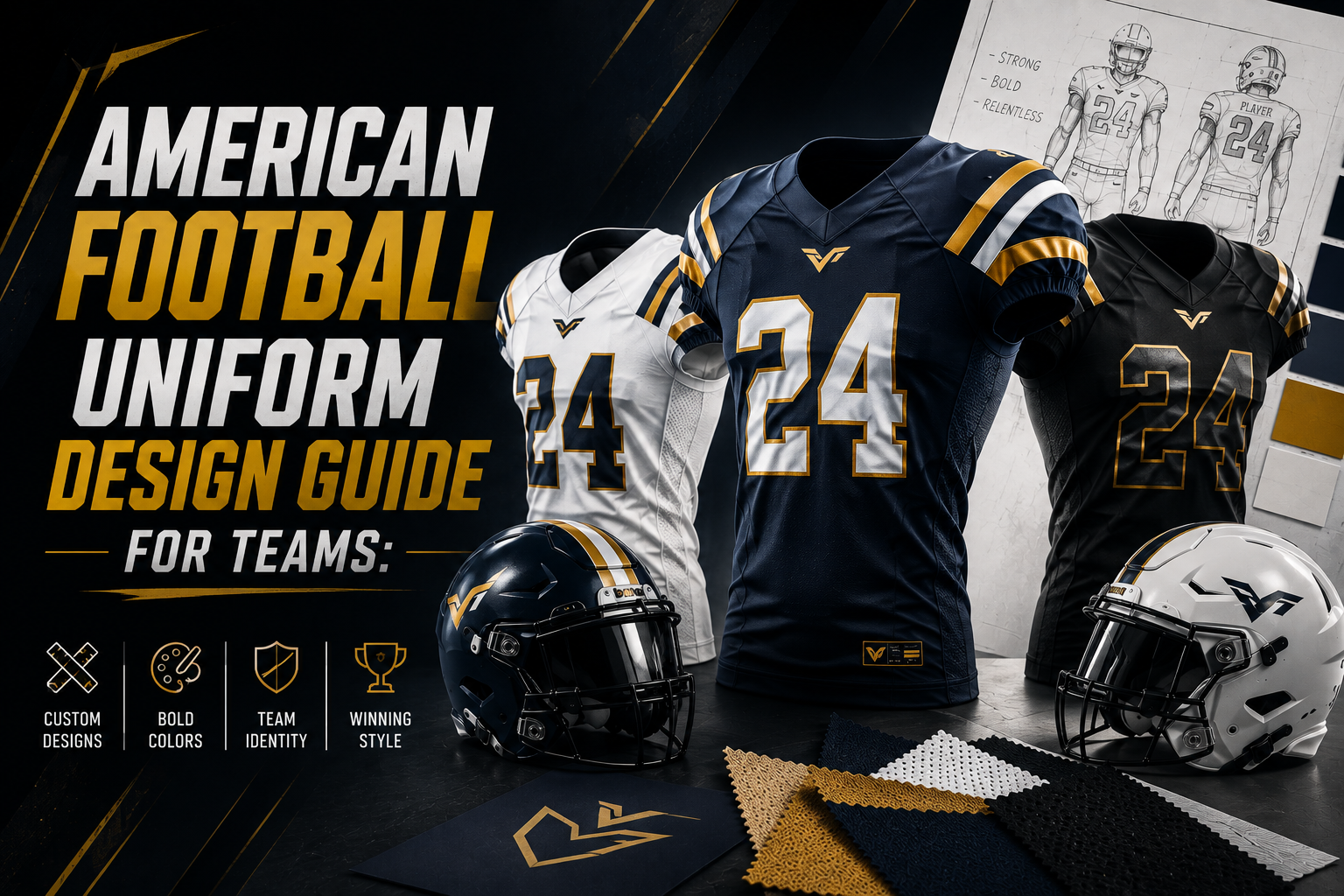
The American football jersey is basically your team’s handshake. Whether you’re ordering one sample or outfitting a full roster, a good custom American football jersey comes down to three things — fabric, fit, and how the graphics are actually laid out.
Fabric first, because it’s the part people overlook until it’s too late. Moisture-wicking polyester blends are standard for a reason: they pull sweat off the body and dry quickly, and they hold their shape through a season of washing. Heavy cotton blends might feel nice on day one, but they soak up sweat, get heavy in the rain, and genuinely slow players down by the fourth quarter.
Fit is the next thing that trips teams up. Too loose and it’s an easy grab for an opponent — refs will call it, but the damage to the play already happened. Too tight and it fights the shoulder pads underneath, which is uncomfortable enough that players start adjusting mid-play instead of focusing on the game. What you want is an athletic cut actually built around pad compatibility, not a generic tee shape someone printed a logo onto.
And then graphics — this is the fun part, honestly. Sublimation printing has mostly taken over as the standard for a custom American football jersey because it lets you use as many colors and gradients as you want without any of it cracking or peeling the way old vinyl transfers did after a dozen washes. Bold numbers you can read from the top row, a clean name plate, a logo placed somewhere it’s actually visible instead of tucked under a pad strap. If you want to see how this comes together in practice rather than just in theory, Jacx Wears has a full custom American football uniform set worth looking at before you commit to anything.
Nobody Talks About the Pants, But They Matter Just as Much
Everyone’s attention goes to the jersey, and the pants get treated like an afterthought, which is a mistake. American football pants take a beating from constant squatting, sprinting, and getting tackled, so you want four-way stretch fabric, reinforced knee panels, and pad pockets that actually stay in place through contact. Cheap pants bunch up mid-play or let the pads slide around — annoying at best, a real safety concern at worst.
For American football shirts worn underneath the pads, or for practice sessions, breathability matters more than anything else. Mesh panels under the arms and along the back make a real difference during those brutal two-a-day sessions in August heat.
And here’s something worth saying plainly: as flag football and women’s tackle leagues keep growing across the country, there’s genuine demand for women’s football pants that are actually built for a different body, not just a men’s pattern shrunk down a size. The cut through the hip and waist needs to change, not just the overall measurements. If you’re vetting a supplier, ask directly whether they treat this as a real product line — check the full range of American football uniforms Jacx Wears offers to see what a proper lineup should look like.
Colors — Where Most Teams Overcomplicate Things
This is the part where teams talk themselves into trouble, not because they pick bad colors, but because they pick too many of them. One dominant color that represents the school or club. One accent color for contrast, whether that’s stripes, trim, or the numbers themselves. And a neutral — white, black, gray — to keep the whole thing readable.
That’s basically it. Once you go past three colors, things start looking cluttered under stadium lights, and more importantly, numbers get harder to read from a distance, which matters a lot more than people think when a ref or a scout is trying to identify a player mid-play.
Keeping the Branding Consistent
Whatever you’re building, whether it’s a single custom American football jersey or a whole team’s worth of custom American football uniform sets, keep the logo placement, number font, and color scheme identical across every piece. It sounds obvious until you see a roster where half the jerseys have the logo on the chest, and the other half have it on the shoulder because two different batches got ordered a year apart. If the budget allows, put names on the back too — it’s a small thing, but it does more for a kid’s sense of belonging to the team than almost anything else on this list.
The Fabric Details That Actually Separate Good From Bad
Not all polyester is created equal, and this is exactly where cheaper suppliers cut corners without you noticing until the second season. When you’re evaluating anyone for American football uniforms, a few honest questions go a long way. Ask about the fabric weight, usually measured in GSM — anything in the 180 to 220 range tends to hold up better under contact. Ask how the fabric handles stretch recovery, because good material snaps back into shape and cheap material just stays stretched out. Ask about the stitching — flatlock seams cause noticeably less chafing than standard overlock stitching. And ask whether the colors have actually been wash-tested, or whether you’re just trusting a sample that hasn’t seen a washing machine yet.
How the Actual Ordering Process Goes
It starts with locking down team identity — colors, logo, mascot, all the stuff that isn’t going to change season to season. From there you pick fabric and fit based on climate and the age group wearing it, because what works for a college program in Texas heat isn’t what works for a youth league in Minnesota. A decent supplier will send over a design mockup before anything goes into production — Jacx Wears does this as a free digital proof, and it’s worth insisting on regardless of who you order from.
Here’s the step people skip and regret skipping: actually comparing that mockup against your roster, line by line. Names, numbers, spelling. It takes twenty minutes, and it’s the difference between a smooth delivery and forty jerseys with a kid’s name spelled wrong. Once that’s approved, you place the bulk order with enough lead time before the season actually starts — production isn’t instant, and you don’t want to be calling in favors two weeks before the opener.
Mistakes That Keep Showing Up
A trendy color scheme that clashes with the school’s existing branding is a common one — something looked good on a mockup, and nobody checked it against the actual mascot or school colors already in use. Prioritizing “cool” over comfort is another; players quietly hate wearing gear that looks good in photos but chafes or overheats. Skipping proper measurements leads to a box full of wrong sizes nobody wants to deal with mid-season. Going cheap on fabric to save money upfront usually means replacing the whole set within a year, which costs more in the long run. And forgetting that women’s or youth fits are actually different products, not smaller versions of the adult cut, is one of the more common and more avoidable mistakes out there.
Frequently Asked Questions
1. How long does it take to get a custom American football uniform made?
Usually somewhere between 3 and 6 weeks, depending on order size and how detailed the design is. Give yourself at least two months before the season starts so you’re not scrambling if something needs a revision.
2. What fabric is best for an American football jersey?
Moisture-wicking polyester with sublimation printing is the standard for good reason — it’s lighter, holds color longer, and doesn’t crack the way older vinyl-printed jerseys eventually did.
3. Do I need to order in bulk, or can I get a small number made?
Both work. Bulk orders, usually 15 pieces or more, tend to get better per-unit pricing, but most manufacturers — Jacx Wears included — will still do smaller runs if that’s what you need.
4. Are women’s football pants actually different from men’s, or just resized?
They’re genuinely different. The cut through the hip and waist needs to fit a different body shape, not just shrink down the men’s pattern to a smaller number.
5. How do I pick team colors without it turning into a mess?
One main color, one accent, one neutral. That’s basically the whole formula. Add more than three and it usually just gets harder to read from a distance.
6. What’s the real difference between sublimation and screen printing?
Sublimation dyes the fabric itself, so it never peels, and you’re not limited to colors. Screen printing costs less upfront but tends to crack or fade faster, especially with how much contact football involves.
7. Are custom uniforms actually worth paying more for?
Generally, yes. They cost more at checkout, but they hold up longer and fit better, so you’re not replacing half the roster’s gear mid-season. Over a full year, it tends to even out or come out ahead.
Where This Leaves You
A good American football uniform design isn’t really about flashy graphics or trying to look the flashiest team on the field. It’s the quiet stuff — comfort that holds up through a full season, colors that still read clearly under stadium lights in November, a fit that doesn’t fight against the pads underneath. Whether you’re ordering a single custom American football jersey as a sample or outfitting an entire roster in matching American football uniforms, the extra hour spent thinking through fabric and fit up front saves you a real headache come week eight. If you want to see what that actually looks like before committing to anything, Jacx Wears works directly with teams and programs across the US — you can get in touch here or browse the full sports uniforms catalog to start figuring out what fits your team.