
Table of Contents
If you’ve been researching how to start a sportswear brand, you’ve probably run into these two terms about a hundred times by now: OEM and private label. And honestly, most explanations online make it sound way more complicated than it needs to be.
So let’s talk about it the normal way, like you’re asking a friend who’s actually worked in a sportswear factory, not reading a textbook.
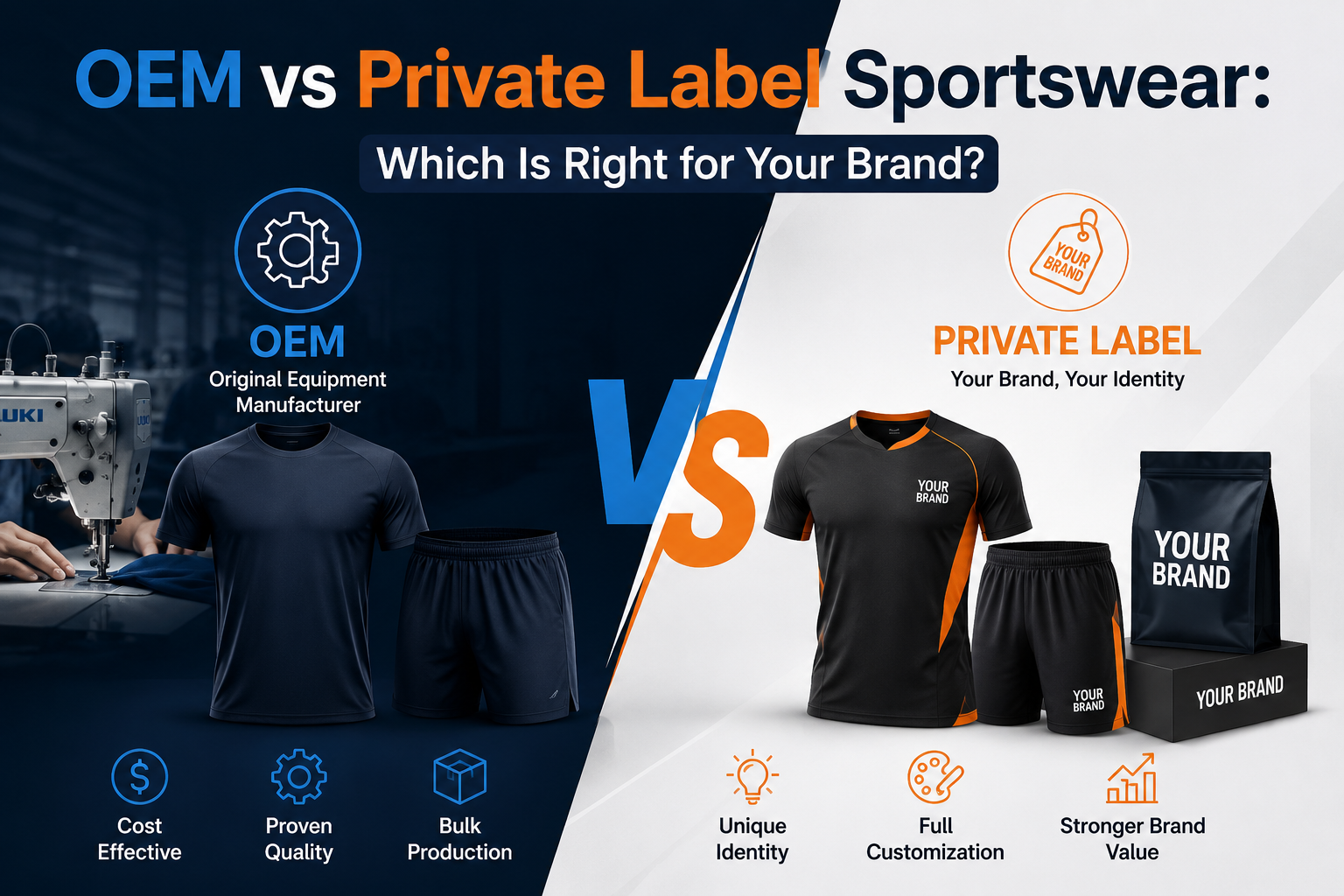
Here’s the short version before we get into details: OEM sportswear means you design the product and the manufacturer builds it exactly to your specs. Private label sportswear means the manufacturer already has the product made (or close to it), and you just put your brand on it. That’s really the core difference. Everything else, pricing, MOQs, timelines, flows from that one distinction.
This same logic applies beyond just activewear, too — it’s really the same conversation people have around private label clothing in general, sportswear is just where it gets specific.
Now let’s break down what that actually means for you, your budget, and how fast you can get your brand off the ground.
First, What Does OEM Sportswear Actually Mean?
OEM stands for Original Equipment Manufacturer, but don’t let the fancy name confuse you. In practice, it just means the factory builds your product from your design. You bring the idea, maybe it’s a specific cut of leggings, a certain waistband height, a proprietary fabric blend you’ve been sketching out for months — and the manufacturer turns that into a real, physical sample.
Think of it this way: if you handed an architect your own blueprint, that’s OEM. You already know what you want. The manufacturer’s job is just to build it well.
This route usually means:
- You’re supplying a tech pack, sketches, or at least a very detailed description of what you want
- The manufacturer creates a pattern from scratch and works with you through several rounds of sampling
- You get full control over the fit, fabric, stitching style, and construction details
- Nobody else selling sportswear will have your exact product, because it was built only for you
- It takes longer — pattern-making and sample rounds eat up weeks, sometimes months
- Minimum order quantities tend to be higher, since the manufacturer is investing real time into developing something new
Basically, OEM sportswear manufacturing is for people who already know what they want and are willing to put in the time (and a bit more money upfront) to get it exactly right.
And What About Private Label Sportswear?
Private label works almost the opposite way. The manufacturer already has proven, tested products sitting in their catalogue, think seamless leggings, compression shorts, sports uniforms, bras, tracksuits — with fits that have already been through the trial and error. You pick from what’s already there, then customize the parts that make it yours: logo, tags, packaging, maybe a colour combo nobody else is using.
This is where a good private label sportswear manufacturer really earns their keep. They’ve already done the hard part. You’re not starting from zero; you’re skipping straight to branding and getting product in hand faster.
A few things that usually come with this route:
- No need for a tech pack, you’re choosing from templates that already fit well and hold up in production
- Turnaround is quicker because there’s no pattern development from scratch
- MOQs are friendlier, which matters a lot if you’re a new brand, watching your cash flow closely
- You can still tweak colours, fabric weight, or small design details in most cases
- The base silhouette might exist elsewhere, too, but your branding is what makes it recognisably yours
Honestly, a lot of the activewear brands you see blowing up on Instagram right now, clean logo, matching leggings and bra sets, solid packaging started exactly this way. It’s not a shortcut in a bad sense. It’s just a smarter way to test the market before investing heavily in original development. If you’ve ever looked into private label clothing outside of sportswear, say, streetwear or basics, you’ll notice it works on the same principle.
Putting Them Side by Side
| OEM Sportswear | Private Label Sportswear | |
| Who designs it | You do, from scratch | The manufacturer already has it developed it |
| Customization | Deep — full control over everything | Moderate — branding plus small tweaks |
| MOQ | Usually higher | Usually lower |
| Time to launch | Weeks to months | Much faster |
| Best for | Brands with a clear, specific vision | Startups wanting to move quickly |
| Upfront investment | Higher | Lower |
| How unique is it | Completely exclusive to you | Shared base, but your branding sets it apart |
The Honest Trade-offs of Each
Nothing about this decision is one-size-fits-all, so let’s just be straight about the downsides, too.
With OEM sportswear, the biggest win is exclusivity; you genuinely own something nobody else is selling. That matters a lot once your brand starts growing and you want customers to recognize your product specifically, not just your logo on something generic. The catch is that it costs more time and money to get there. If your first sample doesn’t fit right (which, to be fair, happens more often than people expect), you’re looking at another round of revisions before production even starts.
With private label sportswear, speed and lower risk are the real advantages. You’re working with a fit that’s already been tested on real bodies, in real fabric, through real production runs. That means fewer surprises. The trade-off is that your product’s “bones” aren’t unique — someone else could theoretically order the same base style. But in practice, most customers connect with a brand through its identity, story, and marketing far more than the exact stitch pattern of a legging, so this matters less than people assume, especially early on.
So, Which One Should You Actually Pick?
Here’s how we usually explain it to people who reach out to us:
If this is your first collection and you’re still figuring out what your customers actually respond to, private label sportswear is almost always the smarter starting point. It gets you real product, in real customers’ hands, without draining your entire budget on development before you even know if the market wants it.
If you’ve already sold a collection or two, you know your customer, and you have a very specific product in mind that doesn’t exist anywhere else, that’s when OEM sportswear manufacturing starts making sense. You’re not guessing anymore. You’re building something deliberate.
A lot of the brands we work with actually do both over time. They start with a private label to build momentum and cash flow, learn what their audience wants, and then move into OEM once they have a clear enough picture to justify the investment. There’s genuinely no shame in starting small here — some of the biggest activewear names today started with exactly that approach.
Where “Custom Sportswear” Fits Into All This
You’ll hear the term “custom sportswear” thrown around loosely, and honestly, it can apply to both models depending on how deep the customization goes. Under OEM, customization means the whole product is built around your idea. Under private label, customization usually means the branding, colours, and small details — while the core fit stays as-is.
A manufacturer worth working with should be upfront about which category your request actually falls into, instead of just agreeing to everything and figuring it out later. If a factory says yes to every single customization request without asking a single question about your budget or timeline, that’s usually a red flag, not a good sign.
Why So Much Sportswear Manufacturing Happens in Sialkot, Pakistan
If you’ve spent any time comparing sportswear manufacturers, you’ve probably noticed Sialkot coming up again and again. There’s a reason for that beyond just cheap labour — which, frankly, isn’t even the main draw anymore.
Sialkot has been producing sports goods for international markets for decades. This isn’t a new industry that popped up to chase trends; entire families here have worked in stitching, embroidery, and garment production for generations. That kind of accumulated skill shows up in the finished product.
A few reasons brands keep coming back to Sialkot specifically:
- The workforce genuinely specializes in sportswear stitching, sublimation printing, and embroidery — not general apparel
- Costs are competitive without the quality drop-off you’d expect at that price point
- A lot of factories, JacxWears included, handle everything in-house, cutting, stitching, printing, and packaging instead of outsourcing pieces to different vendors, which cuts down on delays and quality slips
- Export logistics are already figured out, since these manufacturers have been shipping internationally for years
- Order sizes are flexible enough to support everything from a small private label test run to a full OEM bulk order
So whether you’re specifically searching for a sportswear manufacturer in Sialkot or just a reliable custom sportswear manufacturer in Pakistan more broadly, this city keeps showing up in results for good reason.
Where JacxWears Fits Into This
We’re based right in Sialkot, and we work across both models, OEM and private label sportswear, depending on what a brand actually needs at their stage.
What we try to do differently is keep production in-house. Embroidery, chenille work, screen printing, digital printing, packaging — it all happens under one roof, which means we’re not waiting on a third-party vendor, and neither are you. That matters more than people realize until they’ve dealt with a manufacturer who outsources half their process and can’t tell you why a shipment is late.
We also try not to push everyone toward the biggest, most expensive option. If you’re testing your first small collection, we’ll tell you honestly if private label sportswear makes more sense for where you are right now. If you’ve got a specific design in mind and the volume to back it, we’ll walk you through the OEM process instead.
We ship to brands across the US, UK, Europe, and Australia, and we work with everyone from first-time founders to established fitness wear labels scaling up their product line.
If you’re not sure which route fits your brand yet, that’s a completely normal place to be. Reach out, and we can talk through it before you commit to anything.
Frequently Asked Questions
What is private label sportswear in Pakistan?
It’s essentially activewear leggings, sports bras, tracksuits, hoodies, and similar items that a manufacturer has already developed using their own templates. As a brand, you select from these and apply your own logo, tags, and packaging. Pakistan, and Sialkot in particular, has become a go-to source for this because of the skilled labour base and pricing that’s hard to match elsewhere.
What are the top 10 sportswear manufacturers in Pakistan?
Truthfully, there isn’t one fixed “top 10” list, since rankings shift and different manufacturers specialize in different things. Instead of chasing a list, it’s more useful to look at whether a factory does production in-house, how flexible their MOQs are, how their sample process works, and whether they’ve actually shipped internationally before. JacxWears is one of the manufacturers based in Sialkot offering both custom and private label sportswear production.
How do I find a custom sportswear manufacturer in Pakistan?
Start by checking whether they handle production in-house, cutting, stitching, printing, and embroidery — rather than farming pieces out to different vendors, since that affects both quality and how reliably they hit deadlines. Look at their sample process and MOQ policy, and ask about past export experience. Requesting an actual sample before committing to bulk is still the best way to know if a manufacturer is a good fit.
Are there reliable sportswear websites in Pakistan?
Yes — several manufacturers, JacxWears included, run proper websites where you can browse product categories, request quotes, and start either a custom or private label process directly online. When you’re evaluating one, look for clear product examples, real contact details, and actual information about how they produce, not just a contact form.
What are the top sportswear companies in Sialkot?
Sialkot has a large number of established manufacturers known for team uniforms, custom activewear, combat sports gear, and private label fitness apparel. The ones worth working with tend to be judged on production capacity, years of export experience, and whether they specialize in something specific rather than trying to do everything. JacxWears is among the Sialkot-based manufacturers offering both OEM and private label sportswear services.
Why is Sialkot known for sportswear manufacturing?
It comes down to decades of accumulated expertise, established supply chains for fabric and trims, and export infrastructure that’s already built out. That combination is genuinely hard to replicate quickly elsewhere, which is why the city has held onto this reputation for so long.
What does “sportswear clothing” usually include?
It covers a broad range — leggings, joggers, sports bras, tracksuits, hoodies, jerseys, compression wear, gym tops. Manufacturers like JacxWears produce these under both OEM (fully custom from your design) and private label (branded onto existing, tested templates).
Is Pakistan a good option for sourcing sportswear?
For most brands, yes. Between the manufacturing expertise concentrated in Sialkot, competitive pricing, flexible order sizes, and manufacturers who already have export relationships in place, it’s become one of the more practical sourcing destinations for sportswear brands of pretty much any size.
Final Thoughts
There’s no version of this where one option is objectively better; it really just depends on where your brand is right now. If you need to move fast and keep costs manageable, private label sportswear gets you there. If you’ve got a specific product in mind and the runway to develop it properly, OEM sportswear manufacturing is worth the extra time.
Either way, you don’t have to figure out which one fits by guessing. At JacxWears, we’ve had this conversation with enough brands to know the right questions to ask before you commit to anything. If you’re ready to talk through your options, reach out to our team in Sialkot, and we’ll help you figure out the right starting point.