
Table of Contents
Every brand owner has a version of this story. You find a factory online, the samples look decent, the price is right, and you place your first bulk order feeling pretty good about yourself. Then the shipment arrives, and half the hoodies have crooked seams, the colors don’t match the swatch you approved, and your “two-week” delivery somehow took five. Sound familiar? If it does, you’re in good company; almost every Custom apparel brand goes through some version of this before they figure out what actually matters in a manufacturing relationship.
Here’s what most of them eventually figure out: the factories that keep landing repeat orders from serious brands aren’t necessarily the cheapest ones. They’re the ones who’ve done this hundreds of times before and know exactly where things go wrong before they happen. Big activewear labels rarely jump between suppliers once they’ve found one that works; switching costs more than money. It costs you time, trust, and sometimes your reputation with buyers who don’t care about your production problems, only whether the order arrives on time and in good shape.
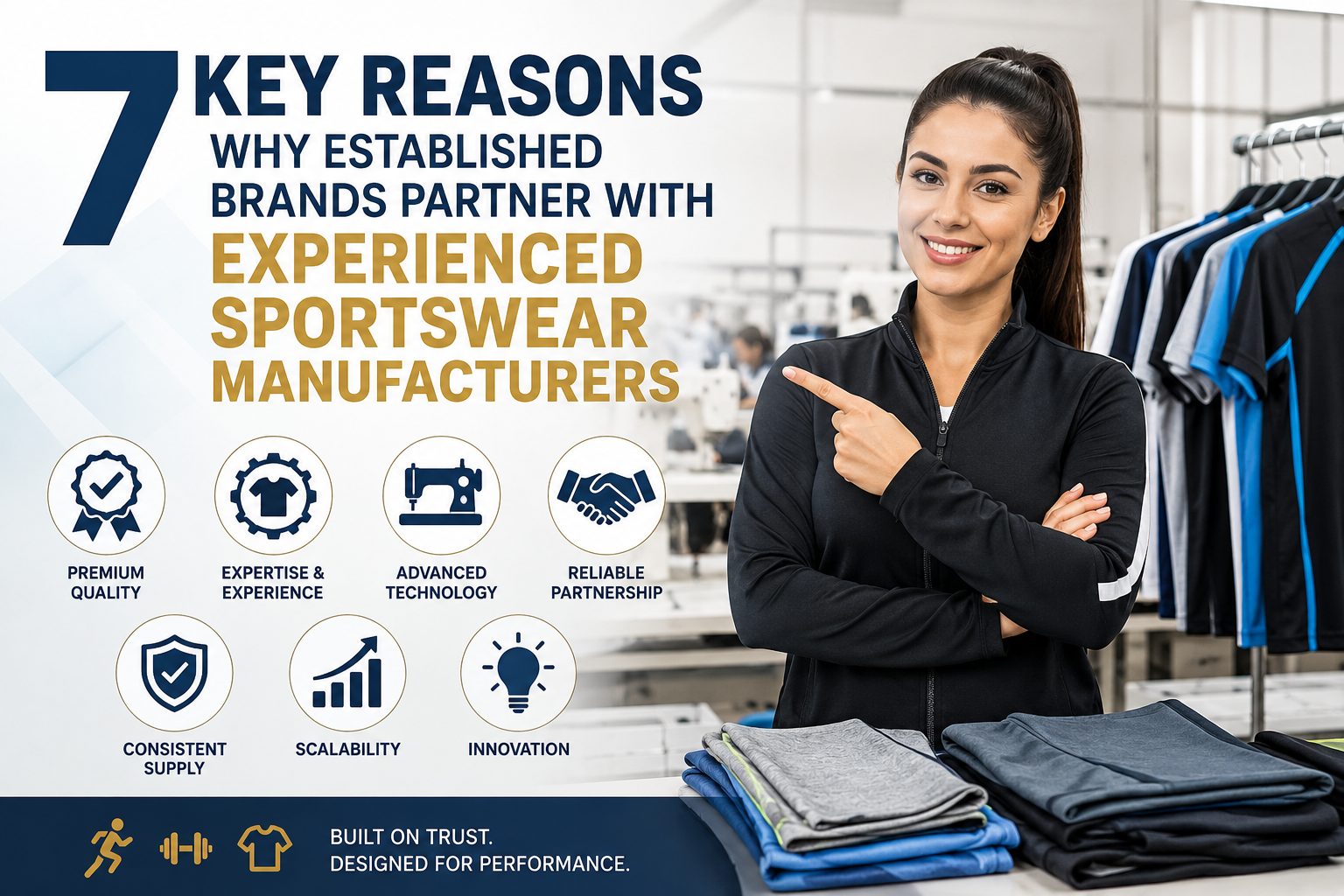
So we wanted to lay out, honestly, why so many established brands eventually land on the same decision: partner with experienced manufacturers instead of chasing the lowest quote. If you’re building a Custom sportswear line and trying to figure out who to trust with your production, this should give you a clearer picture of what actually to look for.
Why “Partner with Experienced Manufacturers” Isn’t Just a Buzzword
New brands tend to shop for factories the way people shop for phone cases lowest price, decent reviews, done. And to be fair, that approach sometimes works fine for a first small batch. It rarely survives contact with a second or third order, though, once volume goes up and margins start to matter.
Established brands have usually already paid the “tuition” on this lesson once. Maybe it was a batch of shorts that shrank two sizes after one wash, or a shipment that missed the holiday season entirely. Once they find a manufacturer who actually understands fabric behavior, compliance paperwork, and realistic timelines, they don’t go shopping again. They stay. Because at that point, they’re not really paying for garments anymore. they’re paying to not have to worry about production. That peace of mind is worth a lot more than saving fifty cents a unit.
1. Quality That Doesn’t Fall Apart After One Wash
Sportswear is unforgiving in a way basic apparel isn’t. A cotton tee that’s slightly off-spec is annoying. A pair of leggings that loses its stretch after a month, or a jersey that pills after three washes, is the kind of thing that gets a brand torched in reviews. Performance fabric behaves differently under stress, heat, and repeated washing, and a factory that hasn’t worked with it enough simply won’t catch the problems until it’s too late.
Manufacturers who’ve been doing this a while build quality checks into every stage instead of scrambling at the end. They check the fabric before cutting, they watch stitch tension as it happens, they inspect before the goods ever get boxed up. Nothing about that is glamorous, honestly. it’s just discipline built from having gotten it wrong before and never wanting to repeat it.
2. They Can Actually Handle It When Your Orders Grow
A small workshop can usually manage your very first sample run without much trouble. The real test comes later — when a retailer suddenly wants 5,000 units, or three of your bestsellers need restocking at the same time right before peak season. This is exactly where a lot of promising brands hit a wall they didn’t see coming.
An experienced B2B garment manufacturer has already built the machinery, the trained staff, and the workflow to flex up or down without everything falling apart. Three hundred units for a soft launch, thirty thousand for a national rollout- the process doesn’t need to be reinvented each time, because it’s already been stress-tested.
3. Real Know-How in OEM and Private Label Work
Not every brand wants to design a collection from scratch, and not every brand wants something generic either. This is where knowing the difference between OEM and private label manufacturing actually matters, and why it helps to work with a factory that’s genuinely good at both, not one pretending to be.
OEM manufacturing means the factory builds garments exactly to your tech pack and specs. The right call if you’ve got a strong, original product idea you don’t want to compromise on. Private label manufacturing means the factory already has developed styles and patterns ready to brand as your own, which is quicker and cheaper if speed to market matters more than a fully custom design.
A manufacturer who’s genuinely experienced won’t just say yes to whichever one you ask for. They’ll tell you honestly which path actually fits your budget and your timeline — even if that means talking you out of the fancier, more expensive option.
4. Prices That Make Sense Without the Hidden Costs
Here’s something a lot of brands only learn the hard way: the cheapest quote is rarely the cheapest outcome once you factor in rejected shipments, rework, late penalties, and the damage a bad batch does to customer trust. Those costs don’t show up on the invoice, but they show up eventually.
Sourcing location plays a real role here too. A Sialkot apparel supplier, for instance, benefits from decades of built-up textile infrastructure and a genuinely skilled labor pool which means competitive pricing without the usual trade-off of cutting corners on quality. Brands that partner with experienced manufacturers in hubs like Sialkot generally get both sides of that equation, not one at the expense of the other.
5. Timelines You Can Actually Plan Around
In sportswear, timing isn’t a minor detail. It’s often the whole game. Miss a seasonal launch window by even a few weeks, and you’re stuck holding inventory until next year, discounting it just to move it. Manufacturers who’ve run production for years understand this pressure because they’ve felt it from the other side, too.
They plan fabric sourcing ahead of time, run stages in parallel where they can, and, this part matters most. They tell you about a possible delay before it happens instead of after. That kind of foresight isn’t something you can teach in a week. It comes from having watched enough shipments go sideways to know the warning signs early.
6. A Long-Term Manufacturing Partner, Not Just Another Vendor
There’s a real difference between a factory that fills your order and a long-term manufacturing partner that actually grows alongside your brand. The second kind remembers your fit preferences without being reminded, keeps your pattern files on file for next season, and flags a fabric price change before it blindsides you.
That relationship saves you an enormous amount of hassle over time. You’re not re-explaining your specs from scratch every few months, or rebuilding trust with a stranger, or training a new supplier on quality expectations you thought you’d already covered once. You just place the next order — and they already know what “right” looks like for your brand.
7. They Already Know the Compliance Rules You Don’t Want to Learn the Hard Way
If you’re selling into the US or European market, compliance isn’t a nice-to-have — it’s the difference between a shipment clearing customs on schedule and one sitting stuck at a port while you’re on the phone trying to figure out why. Labeling rules, fabric testing standards, sourcing documentation, export paperwork all of it has to be right, every time, no exceptions.
Manufacturers who’ve worked with international brands for years aren’t learning these rules on your order. They’ve already built them into how they operate. That one factor alone has saved plenty of brands from a costly delay, a rejected shipment, or a fine they never saw coming.
Mistakes Brands Keep Making Before They Find the Right Partner
Ask almost any established brand about their early sourcing days, and you’ll hear some version of the same regrets. A few that come up again and again:
Chasing the lowest quote without asking what corners are being cut to hit that price. Skipping the sample stage because it feels like an unnecessary delay and then discovering, too late, that the whole bulk order has the same flaw. Not asking about compliance until a shipment’s already stuck somewhere it shouldn’t be. Treating every supplier relationship as disposable, switching for a slightly better price every few months, and never building the kind of trust that gets you priority production slots during a busy season. And honestly, ignoring the early warning signs a factory that’s slow to respond or vague about details before you’ve paid them anything usually doesn’t get more communicative once your money’s on the line.
None of these mistakes are unusual. They’re just avoidable once you know what to watch for, and once you’re working with someone experienced enough to walk you through the process instead of just taking your order and hoping for the best.
What Actually Separates an Experienced Manufacturer From a Beginner Factory
“Experienced” gets thrown around a lot in manufacturing marketing without much behind it, so it’s worth being specific about what it actually looks like in practice. A manufacturer with real experience can tell you how a fabric will behave after fifty washes, not guess at it. They can spot a flawed tech pack before production even starts, not after two thousand units come out wrong. They’ve got documented quality checks at every stage, not just a rushed glance before shipping. They quote timelines they can actually hit, instead of promising something fast because that’s what you wanted to hear. And they’ve already handled export paperwork and customs headaches for markets like the US and Europe, so you’re not the one figuring it out for the first time together.
That’s really the gap between a brand-new supplier and a genuine manufacturing partner not years in business on their website, but how much of that time has turned into a process you can actually rely on.
How to Choose the Right B2B Garment Manufacturer
If you’re comparing manufacturers right now, a few things are worth checking before you commit to anything:
Ask for real production references, not just sample photos; a manufacturer confident in their work won’t hesitate to connect you with existing clients. Start with a smaller trial order before you commit to bulk production; any legitimate factory should be fine proving quality on a modest batch first. Get clear on your own priority up front: are you optimizing for the lowest cost, the fastest turnaround, or the highest quality? Because your ideal partner should match that goal instead of just agreeing with whatever you say. Put the scope of work in writing, covering fabric specs, sampling rounds, timelines, and payment terms, so nothing gets lost between an email and a phone call three weeks later. And trust your gut in those early conversations. if something feels vague or evasive before you’ve signed anything, it usually doesn’t get clearer afterward.
Why Brands Choose JACX Wears as Their Manufacturing Partner
At JACX Wears, we’ve built our name in Sialkot, Pakistan, one of the most established sportswear manufacturing hubs in the world, around exactly the things established brands say they’re looking for: consistent quality control, real production capacity, and communication that doesn’t disappear once the deposit’s paid.
We work as a full-service OEM apparel factory and private label clothing producer, handling custom designs and tech packs, fabric sourcing, embroidery, printing, and even branded packaging under one roof. Whether you’re placing your first serious order or you’re an established label looking for a long-term manufacturing partner who can scale with you into the US and European markets, our team is set up to make that process straightforward instead of stressful.
Tired of chasing suppliers who miss deadlines and can’t repeat their own quality? Get in touch with JACX Wears to request a quote or start a sample order, and see what it’s actually like to work with a manufacturer that treats your brand as a partnership, not a one-off transaction.
Frequently Asked Questions
1. What does it mean to partner with an experienced sportswear manufacturer?
It means working with a factory that has a real track record of producing quality apparel, handling large orders without falling apart, and meeting international compliance and delivery standards rather than a new or unverified supplier still figuring things out on your dime.
2. What’s the difference between OEM and private label manufacturing?
OEM manufacturing builds garments based on your own designs and specifications. Private label manufacturing lets you brand an existing product line as your own. Most experienced manufacturers offer both, so you can pick whichever fits your brand and how fast you need to move.
3. Why do so many international brands source sportswear from Sialkot, Pakistan? Sialkot has decades of specialized textile and sportswear manufacturing know-how, a genuinely skilled labor force, and real export experience, which gives brands a solid balance of competitive pricing and dependable quality. It’s a big part of why working with a Sialkot apparel supplier has become the go-to move for so many brands.
4. How do I know if a manufacturer can actually handle my order volume?
Ask directly about their monthly production capacity, how many clients they’re currently running orders for, and their machinery setup. Then ask for references from brands ordering similar volumes to yours. A manufacturer with nothing to hide will answer all of this without dodging.
5. How long does a custom sportswear order usually take to produce?
It depends on order size and complexity, but a good manufacturer will give you a clear schedule upfront sampling, bulk production, quality checks, shipping — instead of a vague “a few weeks” that turns into two months.
6. Is it actually worth paying more to work with an experienced manufacturer?
In most cases, yes. The cost of rejected shipments, missed deadlines, and quality issues from an inexperienced supplier usually ends up higher than the price difference. Brands that partner with experienced manufacturers tend to save money over time simply because there’s less going wrong along the way.
Looking for a reliable B2B garment manufacturer for your next sportswear collection? Visit JACX Wears to start the conversation.