
You’ve sent the same tech pack to four manufacturers. The quotes come back at $6, $9, $14 and $22 per piece. Nobody explains why.
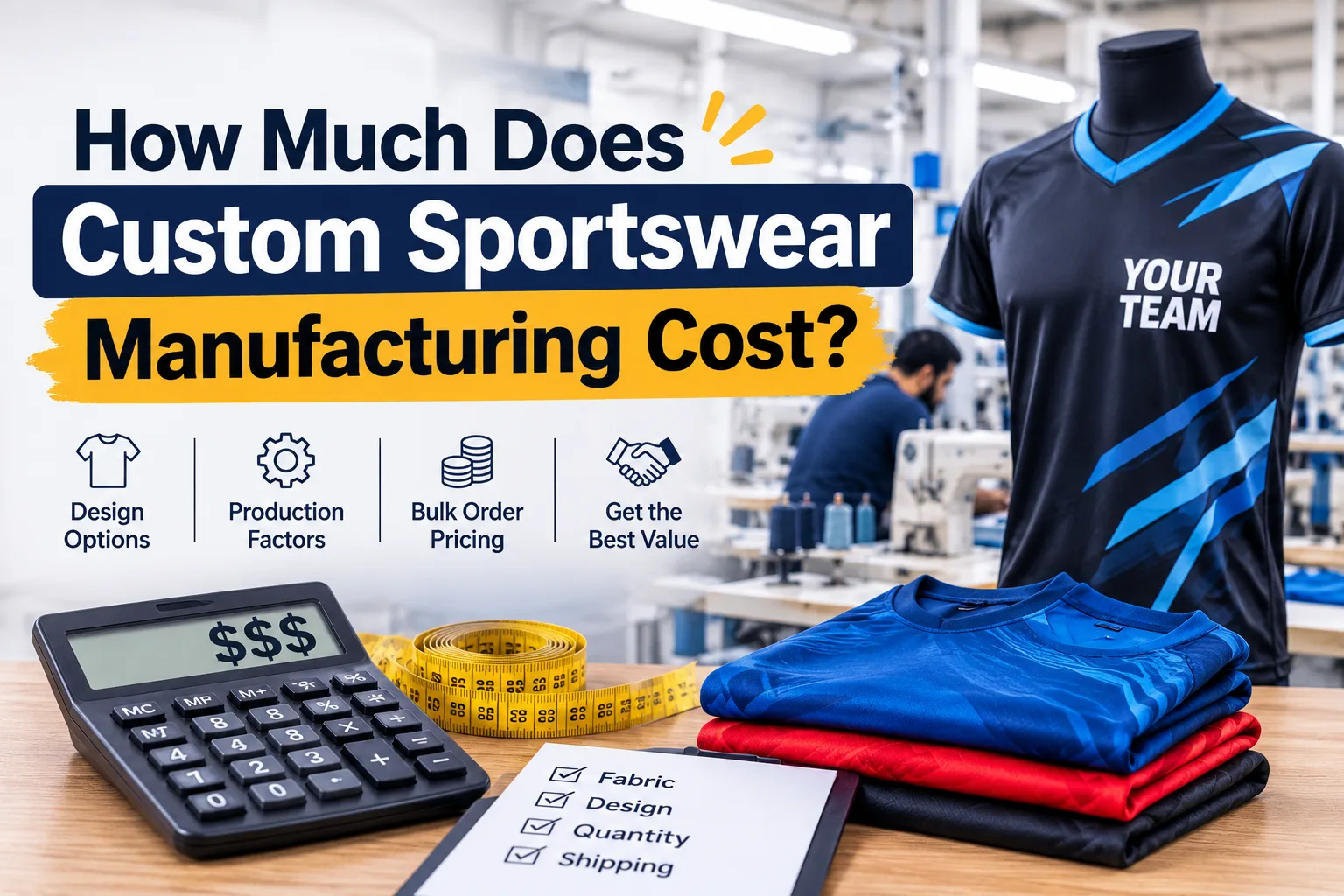
If you’re comparing suppliers, that confusion is normal, and it’s not because someone is lying. It’s because there is no single price for custom sportswear. Each style is priced from five things: the fabric, the construction (labor), the decoration method, the order quantity, and the trims, labels and packaging. Change any one of them and the number moves.
This guide breaks down custom sportswear manufacturing cost line by line, so you can read a quote, compare suppliers fairly and spot what’s missing. We’re JACX Wears, an ISO 9001-certified custom apparel manufacturer in Sialkot, Pakistan, working with B2B buyers in the USA, UK and EU. One note up front: every price range below is an industry estimate from published guides, not a JACX quote. For a real number on your style, request a quote.
Quick takeaways
- Fabric is usually the biggest cost line, often around half of the unit price.
- Decoration method (sublimation, screen print, DTF, embroidery) and construction detail change price a lot.
- MOQ and quantity decide how much setup cost each piece carries.
- Samples, labels, packaging, shipping and duties are real costs that often sit outside the “unit price.”
- A complete quote lists every line. If it doesn’t, ask.
The 5 Things That Set Your Custom Sportswear Pricing
Custom sportswear pricing is built from five inputs. Know them and quotes start making sense.
- Fabric. Type, weight (GSM) and performance features.
- Construction and labor. Number of panels, seam types, details like bonded waistbands or zippers.
- Decoration method. How the logo and graphics get onto the garment.
- Order quantity. Setup costs spread across more pieces get cheaper per piece.
- Trims, labels and packaging. Woven labels, hangtags, polybags, branded boxes.
Shipping, duties and testing sit on top of these, and we’ll cover them in the hidden costs section.
Typical Sportswear Production Cost Ranges (Industry Estimates)
Let’s start with the numbers everyone asks for. These ranges come up often in sourcing guides. Treat them as rough orientation, not as pricing for any specific factory.
- T-shirts: commonly cited at around $2.50 to $5 per piece when made overseas, versus $8 to $15 domestically in the USA.
- Hoodies: commonly cited at around $6 to $12 overseas, versus $18 to $32 in the USA.
- Custom gym wear: one guide puts production at roughly $8 to $35 per unit before shipping, duties or post-production branding.
- Athletic clothing generally: another guide estimates $8 to $25 per piece for wholesale production, with extras like heat-sealed seams or reflective prints adding 10 to 30 percent.
Why such wide ranges? Because a basic cotton tee and a bonded-seam compression legging are completely different products. A range only helps you sense the ballpark. Your actual price depends on the five inputs above.
Overseas versus domestic matters too. In one 500-piece hoodie example, an overseas order ran about $5,050 to $6,290, versus roughly $9,430 to $10,550 domestically. Labor rates and overhead drive most of that gap.
Fabric Cost: The Biggest Line in Your Quote
If you only look at one line, make it fabric. Published guides generally agree that fabric is the largest cost driver, typically 50 to 70 percent of unit cost, although the share varies by garment. For a fleece hoodie, one guide puts fabric and trims at roughly 45 to 55 percent of the unit quote.
What moves fabric cost:
- Fiber type: Polyester, nylon-spandex, cotton-poly blends and technical performance fabrics all price differently.
- Weight (GSM): A heavier 280 GSM fleece costs more than a light 160 GSM jersey.
- Finish and performance: Moisture-wicking, anti-odor, brushed backs or four-way stretch add cost.
- Color: Custom-dyed fabric costs more than stock colors and often has higher minimums.
- Waste: Fabric gets cut with scraps left over. One guide notes waste typically accounts for 10 to 15 percent of material costs.
- A practical tip: if your budget is tight, change the fabric weight or blend before you cut quality in other places like stitching.
Labor Cost (CMT): Why Construction Changes the Price
CMT stands for cut, make, trim. It’s the labor to cut your fabric, sew it and finish it. It’s charged per piece and depends on how many machine minutes your garment takes.
A simple tee has few seams and sews fast. A panelled legging with a bonded waistband, or a jacket with zippers and pockets, takes many more steps. Construction details that raise labor cost:
- More panels and seams
- Flatlock or bonded seams
- Zippers, pockets, drawcords
- Linings and reflective details
- Tight tolerances on fit-critical garments
If you’re comparing quotes, ask each supplier to specify the construction. Two factories can quote the same “hoodie” while one assumes a basic kangaroo pocket and the other includes a lined hood.
Printing Cost: Sublimation, Screen Print, DTF and Embroidery
Decoration is where your brand shows up, and where costs can quietly climb.
- Sublimation: Ink is transferred into polyester fibers. Great for all-over prints and team jerseys, and it doesn’t crack or peel. It needs polyester fabric.
- Screen printing: Good for simple logos in few colors on larger runs, since setup is per color.
- Heat transfer and DTF: Flexible for small runs and detailed artwork.
- Embroidery: Premium look, priced by stitch count and placement.
Things that change printing cost: the number of colors, print size, number of placements, and the setup per design. As a rule of thumb, one small chest logo is cheap. All-over prints with multiple placements and special finishes cost more.
MOQ Pricing and Bulk Order Pricing
Quantity affects price in two ways: the minimum you must order, and the discount you get as you order more.
MOQ pricing. MOQs vary widely. A common range quoted in industry guides is 50 to 300 pieces per style, and there’s a catch: many manufacturers set the minimum per style per color, not per style overall. So a 300-piece MOQ can quietly mean 300 pieces in each color. Always get the minimum per colorway in writing.
At JACX Wears, our MOQ is 20 pieces per style. Small runs cost more per piece, because setup and patterning are spread over fewer garments, but they let you test a design without heavy inventory risk. You can read more about the trade-offs in our low MOQ sportswear manufacturer guide.
Bulk order pricing. Prices drop as quantity grows. We offer volume-tier discounts from 50 pieces upward. A smart move is to ask suppliers to quote the same style at two or three quantities, such as 50, 200 and 500 pieces, so you can see the curve.
Sample Development Cost
Before bulk, you’ll want a sample. This stage has its own costs, and quotes often leave it out.
Typical sample-related costs include the tech pack, pattern making and grading, sample fabric, labor and shipping. One guide suggests budgeting roughly $150 to $350 per style for sampling, and doing multiple rounds if needed.
At JACX Wears, a pre-production sample (PPS) takes 3 to 5 business days. We support tech packs and pattern grading, so you don’t need a perfect file to begin. Sampling feels like an extra expense, but compared with a bulk order that doesn’t fit, it’s cheap insurance. Here’s what to look for in a sample: sportswear quality control before bulk production.
Private Label Apparel Manufacturing Cost: Labels, Packaging and Branding
Private label apparel manufacturing cost includes everything that makes the garment yours, beyond the garment itself:
- Custom woven labels and neck tags
- Hangtags
- Branded polybags, boxes or inserts
- Printed or embroidered logos
These look small individually but add up. One guide suggests budgeting about $0.75 to $2.50 per unit for the full branding layer. If you’re building your own label, our guide on how to start a private label fitness brand covers branding step by step.
Example Cost Breakdown (Illustrative Only)
To make this concrete, here’s a simplified example of how a custom activewear piece breaks down. This is an illustration to show the structure, not a JACX price or a quote.
| Cost line | Example per unit |
| Fabric (240 GSM nylon-spandex) | $5.00 |
| CMT (panelled, bonded waistband) | $4.50 |
| Trims and branding | $1.20 |
On top of these, a full quote would also include decoration, packaging, QC, shipping and any duties. The point of the example is this: in this build, fabric and labor already make up most of the cost before anything else is added. That’s typical for sportswear.
Hidden Costs Buyers Miss
The unit price isn’t the whole price. One sourcing guide warns that final invoices often land 15 to 25 percent higher than buyers expected once everything is counted. Watch for: shanghaigarment
- Shipping and duties. At JACX Wears, we ship DDP (Delivered Duty Paid) door to door to the USA, UK, Germany and the EU via DHL, FedEx and UPS, so duties and taxes are handled upfront and there are no surprise bills.
- Compliance testing. Some markets and products require testing.
- Fabric waste and buffer. Factories need extra material for cutting waste.
- Sampling rounds. Extra revisions add up.
- Rework or defects. A cheap quote with weak QC can cost more in returns. We run in-line QC at every stage plus a final AQL 2.5 inspection.
- Custom components with high minimums. Special trims often have their own minimum purchase.
Ask each supplier for the landed cost, which means the total cost per unit delivered to your door.
How to Compare Manufacturer Quotes
When quotes look very different, compare them line by line. Use this checklist.
- Is the fabric specified (type, GSM, color)?
- Is the construction described, including seams, pockets and details?
- Which decoration method is used, and how many placements?
- What’s the MOQ per style, and per color?
- Are sample costs and lead times listed?
- Are labels, trims and packaging included?
- What are the shipping terms (FOB, DDP) and who pays duties?
- How is quality inspected, and what’s the AQL level?
- What happens if bulk doesn’t match the approved sample?
If a quote leaves out several of these, the price may look low now and grow later. A quote that lists every line is almost always the better comparison, even if the number is higher.
FAQs About Custom Sportswear Manufacturing Cost
How much does it cost to manufacture clothing?
It depends on the garment, fabric, construction, decoration and quantity. Published estimates for custom sportswear range from a few dollars for a basic tee to $25 or more for technical pieces, before shipping and duties. The only reliable way to know your cost is to request a quote for your exact style, fabric and quantity.
How much does it cost to manufacture a Nike hoodie?
There’s no public number for this. Branded hoodies are produced under confidential supplier contracts, and the retail price you see includes design, marketing, distribution and profit, not just manufacturing. What we can tell you is what drives the cost of any custom hoodie: fabric weight and blend, construction, decoration method, quantity, trims and packaging. For your own hoodie, send us your specs and we’ll quote it.
How do I start my own sportswear brand?
Start with a clear niche and a small product range, write a tech pack, order a sample, then place a small first order and scale from there. A low MOQ lets you test with less risk. Our guide on how to start a private label fitness brand walks through each step.
How much does it cost to manufacture a sports bra?
A sports bra costs more than a simple tee because of its construction: multiple panels, elastic, hardware and sometimes padding or a lining. Fabric, trims and labor are the main drivers, and the decoration method adds to it. Because the range is so wide, we can’t give an honest single number here. Browse our sports bra range and send us your design for a quote.
Final Thoughts: Compare Quotes Line by Line
Custom sportswear manufacturing cost isn’t one number. It’s five inputs (fabric, construction, decoration, quantity, trims and packaging) plus the extras that sit around them. Once you can read each line, you can compare suppliers fairly, and you won’t be surprised by the final invoice.
Start by asking for the same specification from every supplier, at the same quantities. Then compare what’s included, not just what’s cheapest.
Want a real number for your style?
Request a free quote and send us your tech pack, sketch or reference photos. We customise to your choice: sizes, fabrics, colors, logos, labels and packaging.
Not sure what to include in your brief? Read our custom apparel ordering guidelines first.