
You approved the artwork, signed off the quote, and paid the deposit. Then 500 jerseys land in your warehouse and the numbers on the back are three millimeters off-center, the collars have shrunk after one wash, and the size medium fits like a large.
That’s a very expensive way to learn why sportswear quality control matters.
At JACX Wears, an ISO 9001-certified custom apparel manufacturer in Sialkot, Pakistan, we see the same pattern with new buyers: most quality problems aren’t hidden, they’re just checked too late. This guide walks you through what to verify before bulk production starts, so problems get caught while they’re still cheap to fix.
Quick takeaways
- Custom sportswear quality control catches fabric, measurement and sewing issues before they get multiplied across your whole order.
- An approved sample sets the quality standard for the entire production run.
- Check eight areas: material, print, cutting, stitching, measurements, roster details, labels and packing.
- In-line checks during production, plus a final AQL inspection, protect you better than a single check at the end.
What Is Sportswear Quality Control?
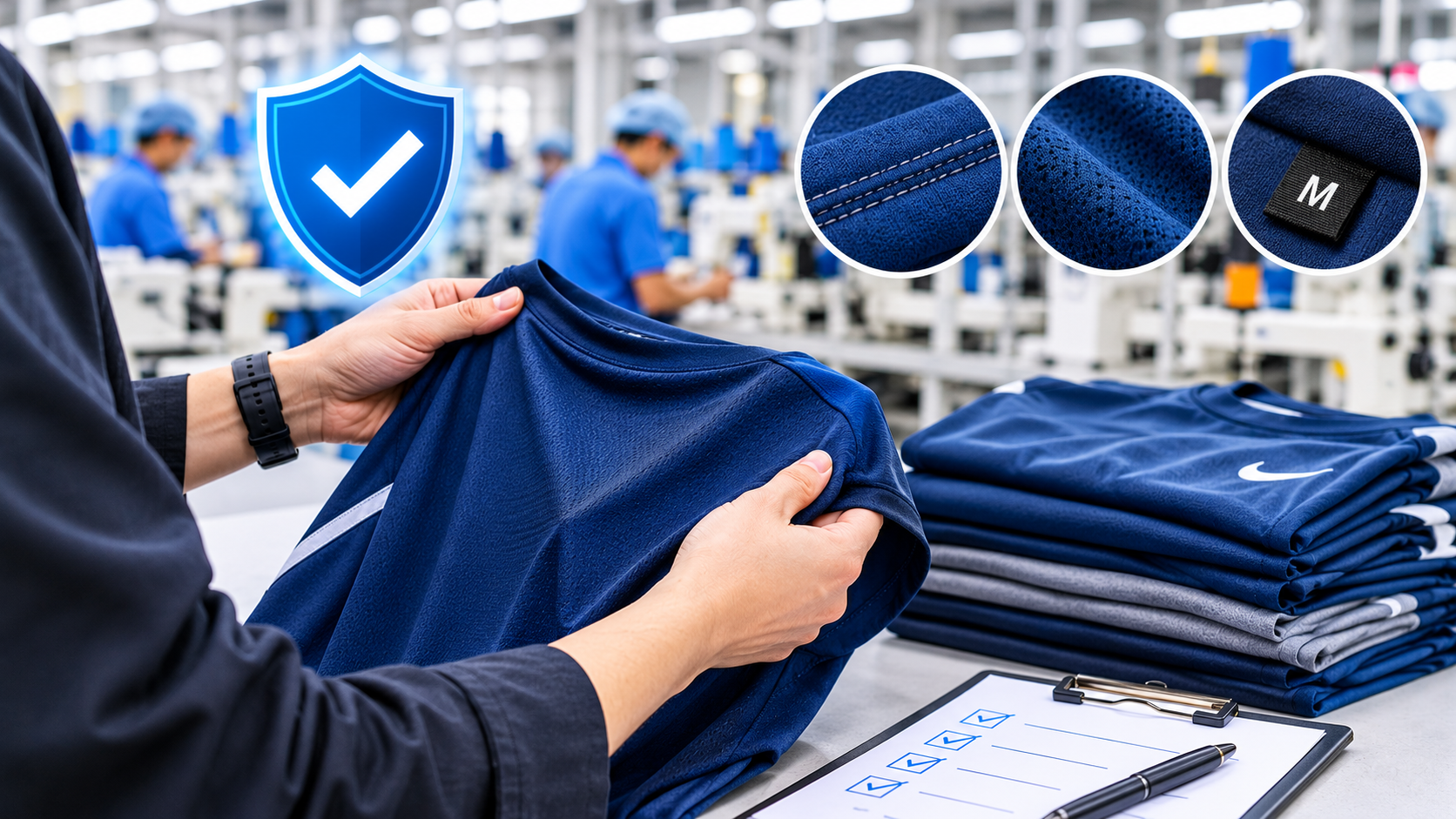
Sportswear quality control is the set of checks a factory makes at every stage of production: fabric inspection, cutting accuracy, in-line checks during sewing and printing, and a final inspection before packing. For custom orders, it covers fabric, size, printing, stitching, labels, packing and final product details.
Think of it as a chain. If one link is weak, for example a fabric roll with uneven stretch, every later step inherits that problem. Third-party inspection companies such as HQTS and V-Trust describe sportswear QC the same way: checks from the first sample through production and pre-shipment, not just a final glance at finished boxes.
The difference with custom sportswear is that every order is unique. Your colors, your logo placement, your player names. There’s no “standard stock” to compare against, which is why your approved sample becomes the benchmark.
Why an Approved Sample Sets the Quality Standard
An approved sample is the one physical reference that both you and the factory agree is “correct.” Everything in bulk production gets measured against it.
Here’s why that matters. Without a signed-off sample, “good quality” is a matter of opinion. With one, it’s a comparison: does the bulk piece match the sample in color, fit, stitching and print placement, yes or no?
At JACX Wears, a pre-production sample (PPS) takes 3 to 5 business days, and bulk production runs about 24 days after you approve it. That sample window is your best chance to catch problems. Use it properly:
- Wash the sample at least once and check for shrinkage, color bleed and print cracking.
- Measure it against your tech pack, not just by eye.
- Try it on a real person, ideally one who matches your size range.
- Photograph it and sign it off in writing, so there’s no argument later about what was approved.
Our custom apparel ordering guidelines cover what to send us before sampling starts.
Custom Sportswear Inspection: 8 Checkpoints Before Bulk
Custom sportswear inspection works best when you break it into specific checkpoints. These are the quality checkpoints we use for custom sublimated sportswear: material, print, cutting, stitching, measurements, roster details and packing, plus labels and trims.
1. Fabric and material
Start here, because fabric problems can’t be fixed later. Check the fabric weight, stretch and recovery, hand feel and shrinkage. For sublimated pieces, the base fabric should be polyester or a high-polyester blend, since sublimation inks bond with polyester fibers.
Ask for a fabric inspection before cutting. Rolls with holes, slubs, shade variation or uneven stretch should be pulled out, not cut and hoped for the best.
2. Print and sublimation quality
Sublimation looks great when it’s right and obvious when it’s wrong. Check:
- Color match: Compare printed panels to your approved color reference, in daylight and under store lighting.
- Print alignment: Patterns and graphics should line up across seams, especially across the front and back panels.
- Edge clarity: Look for blurry edges, ghosting or white gaps near seams.
- Colorfastness: Wash and rub tests show whether darker, saturated colors hold up. Buyer-focused guides like Fabrikn’s sublimated teamwear audit point out that dark, saturated colors usually need tighter control than low-contrast designs.
3. Cutting accuracy
Cutting decides how the garment fits and how the print lands. If panels are cut off-grain or inconsistently, you’ll see twisting side seams and mismatched patterns.
Ask how the factory checks marker accuracy and whether cut panels are numbered by bundle. That way, pieces from different fabric lots don’t end up in the same garment.
4. Stitching and seam strength
Stitching is where sportswear gets tested hardest: sprinting, stretching, pulling, washing. Check for:
- Consistent stitches per inch and straight seam lines
- No skipped or loose stitches, and no puckering
- Reinforced stress points like shoulders, armholes, crotch seams and hems
- Clean thread trimming with no hanging ends
- Stretch seams that flex without popping
Stretch a seam gently by hand. If you hear threads snapping, flag it.
5. Measurements and size grading
Measurement issues are among the most common causes of returns, and they’re easy to prevent. Compare finished garments against your size chart at key points: chest, waist, length, sleeve length and shoulder width.
Make sure the grading between sizes is consistent, too. A jersey that’s perfect in a medium but runs small in a 2XL means the pattern grading needs fixing. We produce sizes from Youth to 5XL, so checking the full size range matters, not only your sample size.
6. Roster details (names, numbers, sizes)
For team orders, this is the checkpoint that causes the most stress at delivery. Before bulk, double-check:
- Spelling of every player name
- Number placement and size on front, back and shorts
- Size assigned to each player
- Matching of numbers across jerseys and shorts
Have two people review the roster spreadsheet. A typo found before printing costs nothing. A typo found after printing costs a reprint.
7. Labels, trims and branding
Check your custom woven labels, neck tags, hangtags and any embroidery or badges. Look at placement, spelling, care instructions and fiber content. Labels get skipped in a lot of inspections, but they’re legally relevant in the USA, UK and EU, and they’re the first thing your customer sees inside the garment.
8. Packing and shipping
The final checkpoint is how the order is packed. Confirm folding method, polybag type, carton labels, piece count per carton and size-wise separation. A perfect order packed badly can still arrive wrinkled, mixed up or short.
If you’re shipping to the USA, UK or EU, ask about packing for DDP (Delivered Duty Paid) delivery, since carton labeling and documentation affect how smoothly it clears.
Apparel Manufacturing Quality Control: In-Line Checks vs. Final Inspection
Apparel manufacturing quality control works best when it happens at multiple stages, not only at the end. A final inspection tells you what went wrong. In-line checks stop it from going wrong in the first place.
In-line QC happens while production is running: checking cut panels, spot-checking print quality, and inspecting sewn garments at each station. If an operator is sewing a seam incorrectly, you’d rather catch it after 20 pieces than after 400.
Final inspection happens when production is finished. A random sample is pulled from the lot and checked against your standards, measurements and the approved sample.
What does AQL 2.5 mean?
AQL stands for Acceptable Quality Limit, and it’s the standard way to decide whether a batch passes or fails. It sets how many defective pieces you can accept in the sample before the entire lot is rejected. AQL 2.5 is a commonly used level for major defects in apparel. At JACX Wears, we run in-line QC at every stage plus a final AQL 2.5 inspection.
As a rough example, standard sampling tables for a lot of 500 to 1,200 pieces typically call for inspecting 80 pieces. Confirm the exact sample size and defect limits with your manufacturer, since they depend on lot size and the inspection level you agree on. A guide like Sino Finetex’s overview of AQL in sportswear gives more background if you want to dig in.
Sportswear Quality Inspection: Common Defects and How to Prevent Them
Sportswear quality inspection is mostly about spotting a short list of repeat offenders. Here’s what to look for and what usually prevents it.
| Defect | What it looks like | How to prevent it |
| Color variation | Panels or garments don’t match in shade | Approve a color reference; check fabric lots before cutting |
| Print misalignment | Graphics don’t line up across seams | Check print and cut alignment on the sample and in-line |
| Shrinkage | Garment is smaller after washing | Wash-test the fabric and the sample |
| Skipped stitches | Gaps or loose seams | In-line stitching checks at each sewing station |
| Wrong measurements | Garment is off from the size chart | Measure against the tech pack at sampling and final QC |
| Roster errors | Wrong name, number or size | Two-person roster review before printing |
| Label errors | Wrong placement or spelling | Approve label artwork and placement in the sample |
If you’re ordering from a new supplier, ask to see their defect log or inspection report format. A factory that tracks defects is usually a factory that fixes them.
Questions to Ask Your Manufacturer Before Approving Bulk
Before you give the green light, ask these questions. A good supplier will answer them without hesitation.
- Do you inspect fabric before cutting?
- How many in-line QC checks happen during production?
- What AQL level do you use for final inspection?
- Can I see photos or a report before shipment?
- What happens if the bulk doesn’t match the approved sample?
- Can you work to my tech pack and size chart?
If you don’t have a tech pack yet, we can help build one. We support tech packs and pattern grading as part of our process.
FAQs About Sportswear Quality Control
What is AQL in sportswear quality control?
AQL (Acceptable Quality Limit) is the maximum number of defective pieces allowed in an inspection sample before a production lot is rejected. In sportswear, AQL 2.5 is commonly used for major defects. JACX Wears runs a final AQL 2.5 inspection on every order, alongside in-line checks during production.
What should I check in a pre-production sample?
Check the fabric, color match, print quality, stitching, measurements, labels and fit, then wash-test it. The pre-production sample is your reference for bulk, so approve it in writing only when everything matches your tech pack.
How do you check sublimation print quality?
Check color match, print alignment across seams, edge sharpness and colorfastness after washing. Compare printed panels to your approved reference, and look at the garment in both daylight and indoor light. Dark, saturated colors deserve extra attention.
What are the most common defects in custom sportswear?
The most common defects are color variation, print misalignment, shrinkage, skipped stitches, incorrect measurements, roster errors and label mistakes. Most of them can be caught with an approved sample, in-line checks and a final inspection.
How many pieces get inspected in a bulk order?
It depends on the lot size and the AQL level you agree on. Inspectors pull a random sample from the lot rather than checking every piece. Ask your manufacturer for the exact sample size and defect limits before production starts.
Final Thoughts: Make Sportswear Quality Control Part of Your Process
Strong sportswear quality control isn’t one big check at the end. It’s a series of smaller checks: fabric before cutting, print before sewing, measurements before shipping, with an approved sample as your reference the whole way through.
Do this well and you’ll spend less time dealing with returns, reprints and unhappy customers. It also tells your factory that you notice details, which usually makes them notice too.
If you’re planning a custom order, you can start with as few as 20 pieces per style, with volume-tier discounts on orders of 50+ pieces. We customize to your choice: sizes, fabrics, colors, logos, labels and packaging.
Ready to start your order with quality checks built in?
Request a free quote or reach us directly:
Send us your tech pack or even a rough idea, and we’ll tell you what we’d check before bulk. You can also see our sports uniforms range and manufacturing facility to see how we work.